Choosing the right engine stand can make engine rebuilding faster, safer, and more organized. Professional shops need more than a high weight rating: dependable rotation, secure mounting, stable casters, and durable construction all matter.
This roundup compares 10 engine stands across common workshop priorities, from compact 750-pound models to heavy-duty 2,000-pound options. Use the guide below to narrow your choice by engine size, available floor space, and day-to-day workload.
Best 10 Engine Stands for Professional Workshops Picks for 2026
Heavy-Duty Workshop Pick
Jackco 1000 lb Rotating Engine Stand

- 1,000 lb professional-grade capacity
- Self-locking 360-degree rotation
- Tool tray and locking swivel casters
Best For: Professional workshops handling heavier engines
Stable Mobile Value
VEVOR 750 lb Rotating Engine Stand

- 750 lb load capacity
- H-shaped base for added stability
- 360-degree arms with mobile casters
Best For: Mobile engine maintenance and repair work
Precision Rebuild Choice
OTC 1726A 1000 lb Engine Stand
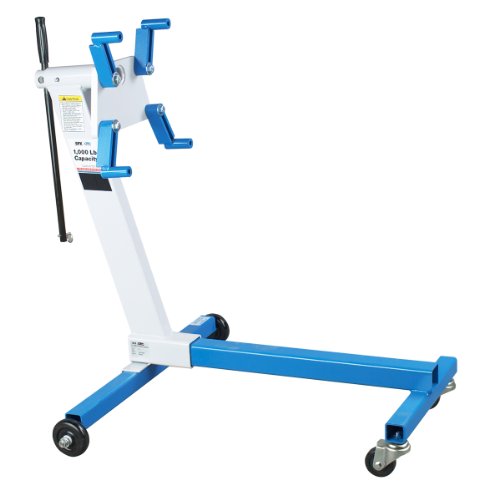
- 1,000 lb capacity for larger assemblies
- Eight locking rotation positions
- Designed for passenger cars and light trucks
Best For: Professional engine rebuilding and repair
Compact Flexible Option
VEVOR Adjustable 750 lb Engine Stand

- Adjustable width and length settings
- Four swivel casters for portability
- Includes two ratchet straps
Best For: Space-conscious workshops with varied engine work
Heavy-Duty Stability Pick
BIG RED 1,500-Lb Rotating Engine Stand

- ASME-tested 1,500-pound capacity
- Four adjustable arms and 360-degree rotation
- H-shaped base with three casters and two brakes
Best For: Professional workshops needing stable, mobile engine support
Maximum-Capacity Folding Pick
Vertlley 2,000-Lb Engine Stand

- Supports engines up to 2,000 pounds
- 360-degree swivel head and adjustable arms
- Foldable H-base with six universal casters
Best For: Heavy engine work where storage space is limited
Space-Saving Mobility Pick
VEVOR 1,500-Lb Rotating Engine Stand

- 1,500-pound capacity with alloy-steel construction
- Five casters with four brakes
- Folds to 14.8 inches wide for storage
Best For: Shops prioritizing compact storage and precise positioning
Portable Rotation Specialist

- 63:1 worm-gear drive with 360° rotation
- Supports up to 1,000 pounds
- Locking swivel casters aid positioning
Best For: Controlled engine rebuilding and inspection
Foldable Heavy-Duty Pick

- 1,500-pound capacity for larger engine blocks
- Four adjustable arms with 360° rotation
- Folds for more compact storage
Best For: High-capacity shop work with limited storage
Maximum-Capacity Workshop Choice
Tolpassa 2,000-Lb Engine Stand

- Supports up to 2,000 pounds
- Six swivel casters and a foldable design
- Four arms with hexagonal-bolt mounting
Best For: Large-engine repair and restoration work
Heavy-Duty Workshop Pick – Jackco 1000 lb Rotating Engine Stand
For professional workshops that need substantial capacity and organized engine work, the Jackco 71000R combines a 1,000 lb rating with 360-degree rotation and a built-in tool tray. Its steel frame and locking swivel casters support mobile, controlled positioning during repairs.
Best For: Professional automotive workshops handling heavier engines and frequent rebuild or maintenance work.
Pros:
- Supports engines up to 1,000 lb.
- Self-locking 360-degree rotation secures the engine at any angle.
- Adjustable mounting arms accommodate different engine sizes and configurations.
- Tool tray and locking swivel casters improve workshop convenience.
Cons:
- At 95 pounds, it is relatively heavy to move and position.
- Its 36-inch-square footprint may require dedicated workshop space.
The Jackco is a strong choice when capacity, controlled rotation, and integrated storage matter more than portability. It is particularly suited to established professional workshops with room for a full-size stand.
Stable Mobile Value – VEVOR 750 lb Rotating Engine Stand
The VEVOR 750 lb engine stand offers a practical balance for professional workshops seeking rotating support without the weight of larger stands. Its H-shaped base, adjustable arms, cast-iron body, and mixed caster setup are designed for stable positioning and movement around the shop.
Best For: Professional mechanics who want a mobile, rotating stand for varied engine maintenance tasks.
Pros:
- 750 lb capacity supports a wide range of engine work.
- 360-degree adjustable mounting arms and six handle location holes aid positioning.
- H-shaped base helps reduce shaking and tilting.
- Two fixed and two swivel casters, including one braked caster, support movement and positioning.
Cons:
- Its 750 lb capacity is lower than the 1,000 lb models in this roundup.
- Only one of the universal casters has a brake.
With a 20-inch handle and adjustable mounting hardware, this VEVOR model is well suited to shops that value maneuverability and flexible access around the engine. Verify the engine weight and mounting compatibility before use.
Precision Rebuild Choice – OTC 1726A 1000 lb Engine Stand
For professional workshops focused on passenger-car and light-truck rebuilding, the OTC 1726A provides a 1,000 lb capacity, four adjustable attachment arms, and full 360-degree engine rotation. Its eight locking positions help hold the work at a preferred angle while the rear wheels anchor the stand.
Best For: Passenger-car and light-truck engine rebuilding or repair in professional shop settings.
Pros:
- 1,000 lb capacity suits substantial engine assemblies.
- Four adjustable arms make mounting straightforward.
- 360-degree rotation with eight locking positions supports access from multiple angles.
- Locking rear wheels and one-bolt disassembly add stability and transport convenience.
Cons:
- At 102 pounds, it is the heaviest listed option.
- Its 46-inch length may need more floor space than compact stands.
The OTC stands out for rebuilders who prioritize secure angle selection and a high load rating. Its larger, heavier design favors a permanent workshop location over frequent relocation.
Compact Flexible Option – VEVOR Adjustable 750 lb Engine Stand
Professional workshops with limited storage or changing engine requirements may prefer this compact VEVOR stand. It supports up to 750 lb, offers adjustable width and length settings, and uses movable mounting posts plus two ratchet straps to secure different engine types.
Best For: Workshops needing a lightweight, adjustable stand for a variety of engines and maintenance locations.
Pros:
- 750 lb capacity with adjustable width and four length settings.
- Four swivel casters make repositioning easy.
- Movable mounting posts support compatibility with most engine models.
- Two ratchet straps provide additional fixation during maintenance.
Cons:
- The casters have no brakes for fixed-position work.
- Its 750 lb capacity is below the 1,000 lb options.
- The compact design may offer less substantial support for especially heavy assemblies.
At 26 pounds, this is the most portable choice in the group, making it useful where stands must be moved or stored regularly. The no-brake caster design is best suited to environments where the stand can be positioned on a suitable level surface.
Heavy-Duty Stability Pick – BIG RED 1,500-Lb Rotating Engine Stand
For professional workshops needing dependable engine stands, the BIG RED AT26801UR combines a 1,500-pound tested capacity with a sturdy H-shaped steel base. Its adjustable mounting arms, 360-degree rotation, and locking casters support accessible, controlled engine work.
Best For: Professional workshops handling most domestic and foreign engine blocks and needing a stable, mobile stand.
Pros:
- ASME-tested capacity of up to 1,500 pounds.
- Four adjustable mounting arms with 2.16-inch hex-head bolts.
- Three 360-degree casters, including two with brakes, for positioning and stability.
- Extra-wide H-shaped base helps reduce shaking and tilting.
Cons:
- Its 73.9-pound weight and large footprint may require dedicated shop space.
- Only two of the three casters include brakes.
This is a practical choice when stability and broad engine compatibility matter more than the smallest storage footprint. The included one-year limited warranty adds useful ownership support.
Maximum-Capacity Folding Pick – Vertlley 2,000-Lb Engine Stand
For professional workshops that regularly handle heavier assemblies, this foldable engine stand offers a 2,000-pound steel capacity, a 360-degree swivel head, and six casters. The folding H-base also helps reclaim floor space when the stand is not in use.
Best For: Workshops and garages working with heavier engines while needing compact storage and easy movement.
Pros:
- Highest stated capacity in this roundup at 2,000 pounds.
- 360-degree swivel head provides access from multiple working angles.
- Foldable H-base collapses for more compact storage.
- Six universal casters support movement around the workshop.
Cons:
- The supplied details do not specify caster brakes.
- The product details do not include a warranty, dimensions, or item weight.
Its combination of high capacity, adjustable arms, and fold-flat storage makes it appealing for busy professional workshops with changing engine projects and limited floor space.
Space-Saving Mobility Pick – VEVOR 1,500-Lb Rotating Engine Stand
Professional workshops seeking engine stands with strong maneuverability and compact storage should consider this VEVOR model. It supports up to 1,500 pounds, uses five wear-resistant casters with four brakes, and folds to a 14.8-inch width for easier stowing.
Best For: Repair shops that need a mobile rotating stand with multiple brakes and a compact storage profile.
Pros:
- Tested 1,500-pound capacity with an upgraded H-shaped base.
- Five 360-degree casters include four brakes for positioning control.
- Adjustable rotating mounting arms and 1.1-inch hex-head bolts secure engine blocks.
- Folds to 14.8 inches wide for space-saving storage.
Cons:
- Its 1,500-pound capacity is lower than the 2,000-pound alternative.
- Five casters may offer a different rolling feel than a six-caster design.
This model stands out when storage efficiency and controlled positioning are priorities. Its alloy-steel construction, rust-protective finish, and four locking casters suit demanding shop environments.
Portable Rotation Specialist – Eastwood Ez Turn Engine Stand
For professional workshops that need controlled engine access without moving the stand constantly, the Eastwood Ez Turn combines a 360-degree rotating head with a 1,000-pound capacity. Its worm-gear drive and locking casters make it suited to methodical teardown, rebuilding, and inspection work.
Best For: Workshops handling engines up to 1,000 pounds that value rotating access and a relatively mobile setup.
Pros:
- 360-degree rotation through a 63:1 worm-gear drive
- Supports engines weighing up to 1,000 pounds
- Includes two stationary and two locking swivel steel ball-bearing casters
Cons:
- Weighs 70.5 pounds, so it is not especially light to reposition
- Uses four casters rather than the five- or six-caster layouts of some competing stands
The Eastwood is a practical choice when precise rotation is more important than maximum capacity. Confirm that your engine stays within the 1,000-pound limit and that the 33-by-36.75-by-36-inch footprint suits your workshop.
Foldable Heavy-Duty Pick – BIG RED 1,500-Lb Engine Stand
The BIG RED rotating engine stand is a strong fit for professional workshops that need more capacity and convenient storage. Its 1,500-pound rating, four adjustable mounting arms, extra-wide base, and foldable frame support demanding repair work while helping conserve floor space.
Best For: Auto repair shops and garages needing a high-capacity stand that folds for storage.
Pros:
- 3/4-ton, 1,500-pound load capacity
- Four adjustable arms and a 360-degree rotating mounting head
- Five casters, including three 360-degree swivel casters, for maneuverability
- Quick folding mechanism helps save workshop storage space
Cons:
- At 84.7 pounds, it is the heaviest of the first two listed options
- The supplied specifications list compact folded dimensions, but not the assembled footprint
With its combination of capacity, adjustable mounting, and foldability, the BIG RED offers a balanced shop-oriented design. It is especially appealing where engines need frequent repositioning but the stand must be stored between projects.
Maximum-Capacity Workshop Choice – Tolpassa 2,000-Lb Engine Stand
For professional workshops working with larger engines, this Tolpassa stand provides the highest stated capacity in the lineup: 2,000 pounds. Its Q235 steel construction, extra-wide U-shaped base, six swivel casters, four bolted arms, and foldable design are aimed at stable, mobile, and space-conscious engine work.
Best For: Professional garages, repair shops, factories, and restoration projects handling engines up to 2,000 pounds.
Pros:
- 2,000-pound capacity with a high-grade Q235 steel frame
- Extra-wide U-shaped base is designed for stability
- Six 360-degree swivel casters support movement around the shop
- Foldable frame and powder-coated finish support storage and durability
Cons:
- The supplied notes do not provide overall dimensions or item weight
- Six swivel casters may require careful placement and locking during stationary work
This is the most capacity-focused option for shops that regularly service SUVs, trucks, and heavier engine assemblies. Before buying, verify mounting compatibility and available floor space, since the supplied information does not specify the complete stand dimensions.
How We Picked These Engine Stands for Professional Workshops
We focused on the features that affect real workshop use: rated capacity, rotating-head design, lock positions, mounting-arm adjustability, caster configuration, frame strength, and storage practicality. The selection includes 750-, 1,000-, 1,500-, and 2,000-pound classes so buyers can match the stand to the engines they service rather than automatically choosing the largest model.
Foldable frames, tool trays, swivel casters, and multiple wheels were also considered because they influence maneuverability and shop-floor organization. Always verify the manufacturer’s rating, mounting hardware, and compatibility with the specific engine before loading a stand.
Quick Comparison
| Capacity class | Best suited for | Main advantage | Potential trade-off |
|---|---|---|---|
| 750 lb | Smaller engines and lighter rebuilds | Lower cost and easier handling | Less margin for heavy assemblies |
| 1,000 lb | General automotive shop work | Balanced capacity and maneuverability | May not suit large truck or diesel engines |
| 1,500 lb | Heavy automotive and light-truck engines | More capacity without the bulk of the largest stands | Requires more floor space |
| 2,000 lb | Large engines and demanding professional use | Maximum capacity and stability potential | Heavier, larger, and harder to reposition |
Key Buying Factors for Engine Stands for Professional Workshops
Capacity and Safety Margin
Choose a stand whose rated capacity comfortably exceeds the complete engine assembly, including accessories that will remain attached. A generous margin reduces strain on the frame and casters, but capacity alone does not guarantee stability. The engine must also be mounted centrally and secured with suitable bolts.
Rotation and Locking
A 360-degree rotating head makes access to the oil pan, rear seal, cylinder heads, and underside of the block much easier. Look for a positive locking mechanism and multiple lock positions rather than relying on friction alone. Confirm that the rotation system remains controllable when the engine is mounted.
Mounting Adjustment
Adjustable arms help accommodate different bolt patterns and engine widths. Longer arms can improve access, but they must be properly supported and tightened. Check whether the mounting hardware fits your engines and whether the head can be positioned without excessive overhang.
Casters, Footprint, and Storage
Four casters may be adequate for lighter work, while five or six wheels can provide improved support for heavier loads. Locking casters help prevent movement during wrenching. Foldable frames save space, but confirm that the folded design does not compromise rigidity when opened and loaded.
Who Should Buy Which Engine Stands for Professional Workshops?
Choose a 750-pound stand for smaller engines, occasional rebuilds, or shops that prioritize compact handling. A 1,000-pound model is the practical all-around choice for many automotive repair businesses. Move up to 1,500 pounds for frequent light-truck work or heavier engine assemblies. A 2,000-pound stand is best for professional users who routinely handle large engines and have enough floor space for a wider, heavier frame.
For any capacity, inspect welds, hardware, casters, and locking components before use. Keep the engine balanced, use the correct mounting bolts, lock the casters during service, and follow the manufacturer’s loading and operating instructions.