A car heads-up display can put speed and selected vehicle data in your line of sight, helping you check key information without looking down at the instrument cluster.
These 10 options include GPS and OBD2 models, large projected readouts, overspeed alerts, and added data such as RPM, coolant temperature, and fuel usage. Use the guide below to match the display type and features to your vehicle and driving habits.
Best 10 Car Heads Up Display Picks for 2026
Large-Screen GPS Safety Pick

- Large display shows speed and trip information
- GPS-based operation for universal vehicle use
- Overspeed and fatigue-driving alerts
Best For: Drivers seeking a large GPS speed display with safety reminders
Versatile Diagnostic Display
- Combines OBD2 and GPS data modes
- Displays speed, RPM, voltage, and temperatures
- Supports dashboard or windshield installation
Best For: Drivers wanting vehicle diagnostics alongside speed information
OBD2 Warning-Focused Choice
- Large screen with broad vehicle-data display
- Includes fault-code and multiple safety alerts
- Automatic power and brightness functions
Best For: Compatible vehicles needing dashboard data and warnings
Feature-Rich Performance Monitor

- OBD2 and GPS systems provide broad data coverage
- Gesture control, themes, and ambient lighting
- Includes acceleration and braking tests
Best For: Drivers and enthusiasts wanting extensive customization and performance data
Best OBD2 Windshield Projector
- Large 5.5-inch windshield display
- Shows speed, RPM, temperature, and voltage
- Automatic brightness and overspeed warning
Best For: Compatible gasoline vehicles needing detailed OBD2 data
Best Dual-Mode Car HUD

- Supports OBD and GPS operating modes
- Displays speed, voltage, and temperature data
- Automatic brightness with unit selection
Best For: Drivers needing a flexible option across vehicle types
Best GPS Car HUD

- GPS+BDS positioning with 10Hz refresh
- USB plug-and-play installation
- Adjustable brightness and speed calibration
Best For: Drivers wanting a compact GPS speed display without OBD2
Best OBD2 Windshield HUD
MAIMEIMI Multi-Function Speedometer

- Projects speed directly onto the windshield
- Shows RPM, temperature, voltage, and fuel-use data
- Includes four configurable driving alerts
Best For: Compatible gasoline vehicles needing detailed OBD2 data
Best GPS Plug-and-Play HUD

- USB-powered with no OBD port required
- Large MPH display with automatic brightness
- GPS and BDS positioning refresh at 10Hz
Best For: Cars, trucks, and motorcycles with a USB port
Best Large-Screen OBD2 HUD
5.5-Inch Multifunction Display

- Large HD screen supports MPH and KMH
- Shows multiple vehicle gauges and alerts
- Adds fault detection and code-clearing functions
Best For: Drivers wanting a large OBD2 display with diagnostic features
Large-Screen GPS Safety Pick – SinoTrack 5.5-Inch GPS HUD
If you want a straightforward car heads up display focused on speed and driving awareness, the SinoTrack offers a large 5.5-inch screen with GPS-based readings. It can show speed, driving time, mileage, time, direction, and satellite information, while automatic brightness adjustment helps keep the display readable in changing light.
Best For: Drivers who want a large, universal GPS speed display with overspeed and fatigue reminders.
Pros:
- Large 5.5-inch screen displays speed and several trip details together.
- GPS operation is designed for use across vehicles without relying on OBD data.
- Includes adjustable overspeed and four-hour fatigue-driving alerts.
- Automatic light-sensitive brightness adjustment supports daytime and nighttime viewing.
Cons:
- It displays current-trip mileage and does not retain or accumulate distance after power is removed.
- Requires a 5V power supply; using a higher voltage is prohibited.
- Its data focus is narrower than models that read extensive vehicle diagnostics.
The SinoTrack is a practical choice when screen size, GPS universality, and safety reminders matter more than deep engine-data monitoring. Its one-key controls and automatic brightness make it relatively simple to use.
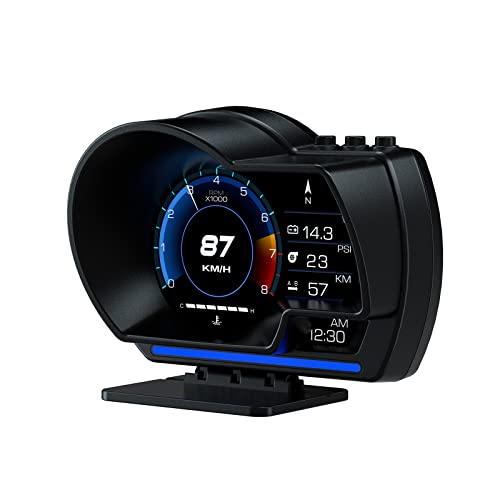
Versatile Diagnostic Display – wiiyii P6 OBD2/GPS HUD
The wiiyii P6 combines OBD2 and GPS functions in a car heads up display designed to keep speed and vehicle information in view. Depending on vehicle compatibility, it can show data such as voltage, fuel consumption, RPM, and water temperature, while its adjustable bracket supports dashboard or windshield placement.
Best For: Drivers who want a flexible OBD2/GPS display with broad vehicle-data coverage and multiple mounting options.
Pros:
- Uses OBD2 and GPS modes together for more comprehensive readings.
- Can display speed, voltage, fuel consumption, RPM, and water temperature.
- Offers 10 interfaces, adjustable brightness, and red visual warning illumination for abnormal driving.
- Supports dashboard or windshield installation without destructive mounting.
Cons:
- OBD data availability depends on whether the vehicle supports the required OBD2 protocol.
- Vehicles without compatible OBD2 may use only the GPS function.
- The unit provides substantially more information than drivers seeking only a simple speed display may need.
Choose the P6 if you want a compact dashboard companion that can expand beyond speed readings. Its dual-mode design is particularly useful for buyers who want GPS fallback when full OBD2 compatibility is unavailable.
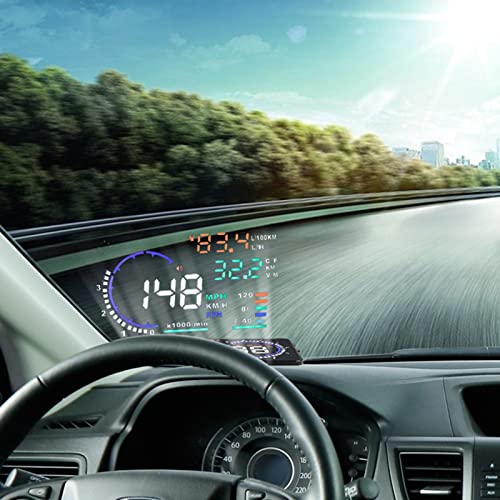
OBD2 Warning-Focused Choice – 5.5-Inch Multi-Color HUD
This 5.5-inch car heads up display projects key dashboard information toward the driver’s line of sight and connects through an OBDII/EUOBD interface. It shows speed, engine speed, temperatures, voltage, fuel-consumption figures, mileage, and fault codes, with visual and audible-style alerts for several driving conditions.
Best For: OBDII or EUOBD-compatible drivers who want a large display with vehicle warnings and diagnostic information.
Pros:
- Large 5.5-inch screen supports speed, RPM, water temperature, voltage, fuel use, and mileage readings.
- Displays fault codes for compatible vehicles.
- Provides overspeed, fatigue-driving, high-temperature, low-voltage, and shift reminders.
- Offers automatic or manual brightness adjustment and automatic power on/off with the vehicle.
Cons:
- Compatibility is limited to vehicles using OBD II or EUOBD systems.
- Its feature set depends on the vehicle’s available diagnostic data.
- The supplied details do not describe GPS functionality, so it is less universal than GPS-based alternatives.
This model makes sense for buyers who prefer a prominent screen and multiple vehicle alerts through an OBD connection. Confirming your vehicle’s OBD II or EUOBD compatibility is important before choosing it.
Feature-Rich Performance Monitor – wiiyii P28 HUD
The wiiyii P28 is a feature-rich car heads up display for drivers who want more than basic speed information. Its OBD2 and GPS systems can present vehicle data, configurable themes, gesture control, colorful ambient lighting, alarms, and performance-testing screens, including acceleration and braking measurements.
Best For: Enthusiasts who want extensive vehicle monitoring, customizable presentation, and performance-oriented features.
Pros:
- Combines OBD2 data access with universal GPS functionality.
- Displays speed, RPM, temperature, voltage, fuel consumption, compass, altitude, and turbo pressure data.
- Offers 13 themes, gesture control, adjustable mounting, and multiple language and calibration settings.
- Includes acceleration, braking, and dynamic-curve functions for performance reference.
Cons:
- OBD functionality remains dependent on vehicle compatibility.
- The number of features and settings may be more than needed for drivers seeking a simple speed readout.
- Turbo-pressure and other specialized readings may not be relevant or available on every vehicle.
The P28 stands out for customization and data depth rather than minimalism. It is a strong fit for technically minded drivers who will use its gesture controls, alarms, configurable display, and performance screens.
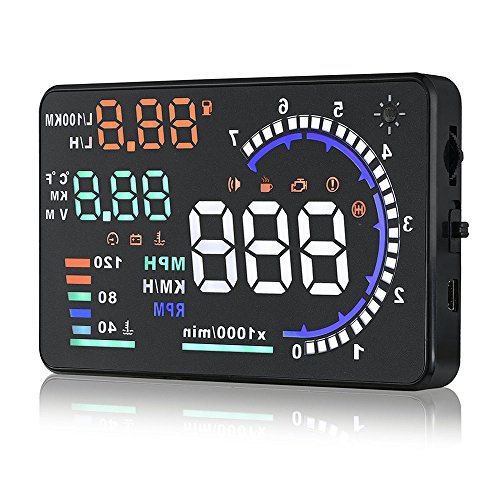
Best OBD2 Windshield Projector – 5.5-Inch A8 Car HUD
This 5.5-inch car heads up display is a plug-and-play OBD2 unit for compatible gasoline vehicles. It projects speed, RPM, water temperature, voltage, and mileage onto the windshield, while adjustable brightness and an overspeed alert support easier monitoring on the road.
Best For: Drivers with a compatible OBD II gasoline vehicle who want a larger, information-rich windshield display.
Pros:
- Large 5.5-inch display with automatic or manual brightness adjustment.
- Shows speed, RPM, water temperature, voltage, and mileage.
- Includes overspeed warning and automatic ignition-linked power control.
- Anti-ghosting reflective film supports a sharper projection.
Cons:
- Compatibility is limited; it does not support several listed brands and select Hyundai/Kia models.
- Designed for compatible gasoline vehicles rather than every vehicle type.
Choose this model when display size and OBD2 engine data matter most. Verify vehicle compatibility before ordering, especially if your car is from an excluded brand or market.
Best Dual-Mode Car HUD – M7 OBD/GPS Speedometer
This car heads up display combines OBD and GPS modes to show driving information on the windshield. OBD mode adds data such as water temperature and driving distance, while GPS mode provides a broader compatibility option for vehicles that cannot use OBD2.
Best For: Drivers who want a flexible HUD with both vehicle-data and GPS-based operating modes.
Pros:
- OBD mode displays speed, water temperature, voltage, and driving distance.
- GPS mode is intended for vehicles incompatible with OBD mode.
- Supports speed, water temperature, and voltage alarms depending on mode.
- Offers automatic brightness adjustment and selectable MPH or KM/H units.
Cons:
- OBD II mode is limited to applicable vehicles and is not compatible with listed electric, diesel, pickup, RV, and modified vehicles.
- The product notes state that purchases have no return or exchange.
The M7 is a practical choice if compatibility is your main concern, provided you use GPS mode when OBD2 is unsuitable. Confirm which operating mode fits your vehicle before purchase.
Best GPS Car HUD – K4 10Hz GPS Speedometer
This GPS-based car heads up display uses GPS and BDS satellite signals to provide speed information without requiring an OBD2 connection. Its USB plug-and-play setup, 10Hz refresh rate, adjustable brightness, speed calibration, and overspeed alert make it a straightforward choice for displaying speed in MPH or KM/H.
Best For: Drivers seeking a compact, USB-powered GPS speed display with broad installation flexibility.
Pros:
- Dual GPS+BDS reception supports up to 32 satellite signals and a 10Hz refresh rate.
- USB 5V plug-and-play power simplifies installation.
- Switches between MPH and KM/H and supports manual speed calibration.
- Offers adjustable brightness and a customizable overspeed alert.
Cons:
- GPS performance may be affected in tunnels, underground garages, severe weather, or behind metallic windshield film.
- Primarily provides GPS-based speed information rather than OBD engine data.
The K4 suits buyers who want simple GPS speed projection and do not need engine metrics such as RPM or water temperature. Its compact design and USB power make it easy to add to many vehicles.
Best OBD2 Windshield HUD – MAIMEIMI Multi-Function Speedometer
If you want a car heads up display that reads vehicle data directly from the onboard computer, the MAIMEIMI HUD is a practical option for compatible gasoline vehicles. It projects speed onto the windshield and can also show RPM, water temperature, voltage, trip information, and fuel-use data.
Best For: Drivers with a compatible 2008-or-newer gasoline car who want OBD2 vehicle data and configurable alerts.
Pros:
- Projects large, real-time speed data onto the windshield.
- Displays multiple vehicle metrics, including RPM, temperature, voltage, and fuel-use information.
- Offers overspeed, fatigue-driving, speed, and engine-failure alarms.
- Automatic brightness adjustment supports daytime and nighttime viewing.
Cons:
- Compatibility is limited to supported OBDII/EOBD gasoline vehicles.
- Does not support listed OBDI, JOBD, hybrid, diesel, and several specific brands or models.
- Requires manual speed calibration if the displayed reading differs.
This is a feature-rich choice for buyers who prioritize direct OBD2 data rather than a basic GPS speed reading. Check the extensive compatibility list carefully before ordering.
Best GPS Plug-and-Play HUD – K1 USB GPS Speed Display
For shoppers seeking a simple car heads up display without relying on an OBD port, this GPS model uses USB power and satellite positioning. Its large MPH display, automatic brightness adjustment, and windshield projection make it a straightforward fit for many cars, trucks, and motorcycles with a USB port.
Best For: Drivers wanting a broadly compatible, USB-powered GPS speedometer with a large, easy-to-read display.
Pros:
- Uses GPS and BDS positioning with a 10Hz refresh rate.
- Requires no OBD connection and works with vehicles equipped with USB power.
- Automatically adjusts brightness for different lighting conditions.
- Compact display uses large MPH figures and anti-reflective shading.
Cons:
- GPS speed can vary by approximately 0.6–1.8 MPH.
- Signal performance may be affected in tunnels, garages, poor weather, or behind metallic windshield film.
- Displays speed rather than the broader vehicle metrics available from some OBD2 units.
This HUD is a convenient pick when vehicle compatibility and easy setup matter most. Its GPS-based operation avoids OBD limitations, but satellite signal conditions can affect performance.
Best Large-Screen OBD2 HUD – 5.5-Inch Multifunction Display
This car heads up display is designed for drivers who want more than a projected speed reading. Its 5.5-inch HD screen can show MPH or KMH along with RPM, water temperature, voltage, fuel consumption, and selected alerts, while its OBD2 connection also supports fault detection and code clearing.
Best For: Car owners seeking a large, multifunction OBD2 display with basic diagnostic capabilities.
Pros:
- Uses a large 5.5-inch HD display with automatic brightness adjustment.
- Shows speed, RPM, water temperature, voltage, and fuel consumption.
- Provides speeding and voltage alerts.
- Supports fault detection, failure alarms, and failure-code clearing.
Cons:
- Requires a compatible OBD2 or EOBD vehicle and available OBD2 port.
- The larger housing may take more dashboard space than compact HUD units.
- Features depend on the vehicle’s supported OBD2 data and protocols.
Choose this model if screen size and vehicle information are higher priorities than minimalism. Its diagnostic functions add useful capability, but buyers should verify OBD2/EOBD compatibility before purchase.
How We Picked the Best Car Heads Up Display
We focused on models that provide a practical way to view driving information through a windshield-mounted or dashboard-positioned display. The selection covers both GPS units, which generally work across a wider range of vehicles, and OBD2/EUOBD units, which can read data directly from a compatible vehicle computer.
We also considered display size, speed-unit support, installation requirements, alert functions, and the usefulness of extra readings. Because compatibility and included accessories can vary, confirm the product specifications before ordering.
Quick Comparison
| Display type | Best for | Typical information | Installation |
|---|---|---|---|
| GPS HUD | Broad vehicle compatibility | Speed, overspeed alerts, driving reminders | Power cable and GPS positioning |
| OBD2 HUD | Vehicles with compatible diagnostic ports | Speed, RPM, coolant temperature, fuel data | Plug into OBD2/EUOBD port |
| Large-screen HUD | Drivers who prefer easy-to-read figures | Speed and selected vehicle data | Dashboard or windshield placement |
Key Buying Factors for a Car Heads Up Display
GPS or OBD2 Compatibility
GPS models are usually the safer choice when you do not know whether your vehicle supports the required OBD2 protocol. OBD2 models can offer richer vehicle information, but compatibility, port location, and supported data may differ by vehicle year, market, and engine.
Readability and Placement
Look for a bright, high-contrast screen with adjustable display settings. A 5.5-inch model may be easier to read, but it also takes more dashboard or windshield space. Position the unit where it does not block your view or create distracting reflections.
Useful Alerts and Measurements
Overspeed alarms can be helpful for drivers who want a reminder when approaching a chosen limit. Fatigue alerts, RPM, coolant temperature, fuel consumption, and voltage readings are useful extras, but they should not replace the vehicle’s warning lights or normal maintenance checks.
Units and Setup
Check whether the display supports MPH, KM/H, or both. Confirm that the package includes the required power cable, reflective film, mounting materials, and any OBD2 adapter. A simple plug-in setup is preferable if you regularly switch vehicles.
Who Should Buy Which Car Heads Up Display?
Choose a GPS HUD if you want broad compatibility, a straightforward speed display, or a unit for an older vehicle without a suitable diagnostic connection.
Choose an OBD2 HUD if your car has a compatible port and you want access to RPM, coolant temperature, fuel-related information, or other vehicle data.
Choose a large-screen model if quick readability is your priority, especially during daylight driving. Drivers who want a cleaner setup should favor compact units with minimal cables and adjustable brightness.
Whichever type you select, treat the Car Heads Up Display as a supplemental instrument. Set it up before driving, verify its speed reading against the vehicle or a trusted source, and keep the projection positioned outside your essential field of view.