Older cars can gain a useful modern upgrade without replacing the factory stereo or dashboard. A head-up display can project speed and driving alerts into your line of sight, helping you spend less time looking down at the instrument cluster.
This roundup compares 10 options ranging from plug-and-play GPS units to OBD2 displays and models with wireless smartphone integration. The right choice depends on your car’s compatibility, preferred features, display clarity, and installation needs.
Best 10 Car Head Up Displays for Older Cars Picks for 2026
Best OBD+GPS Value
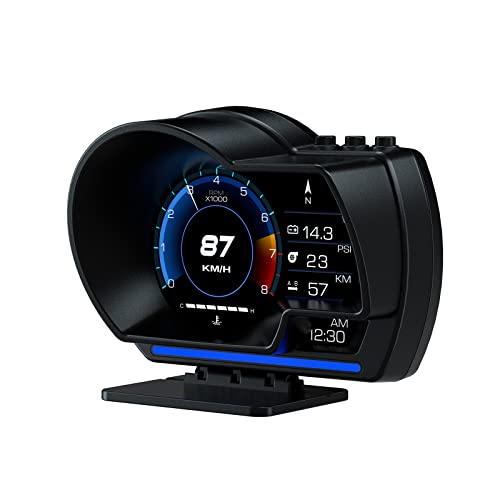
- OBD and GPS dual-mode operation
- Shows speed and multiple vehicle metrics
- Dashboard or windshield mounting
Best For: Drivers needing flexible compatibility and detailed readings
Best Feature-Rich Upgrade

- GPS works without model-specific OBD compatibility
- Wireless CarPlay and Android Auto
- Includes dual power options and heat protection
Best For: Older cars needing navigation and smartphone integration
Best Compact Basic Display

- Small 40 g form factor
- Includes reflective film and anti-slip pad
- USB-powered installation accessories included
Best For: Drivers wanting a lightweight, simple HUD
Best Clear OBD2 Readout

- 3-inch high-definition display
- Shows speed, RPM, temperature, and voltage
- Automatic startup and shutdown
Best For: OBD II or EUOBD-equipped cars needing clear vehicle data
Best GPS Pick

- GPS-based speed tracking for many 12V vehicles
- Bright auto-adjusting display with six modes
- Overspeed and fatigue-driving alerts
Best For: Older cars needing a simple, non-OBD speed display
Best Large-Screen Option
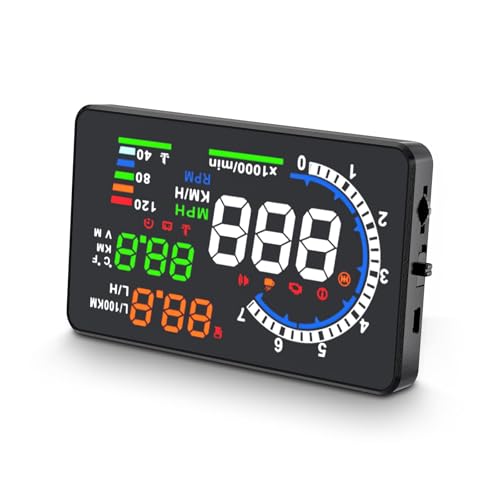
- 5.5-inch HD screen with 800x480 resolution
- Displays speed, temperature, voltage, and distance
- Reads vehicle fault information on compatible cars
Best For: OBDII or EOBD vehicles needing detailed readouts
Best Data-Rich OBD Pick
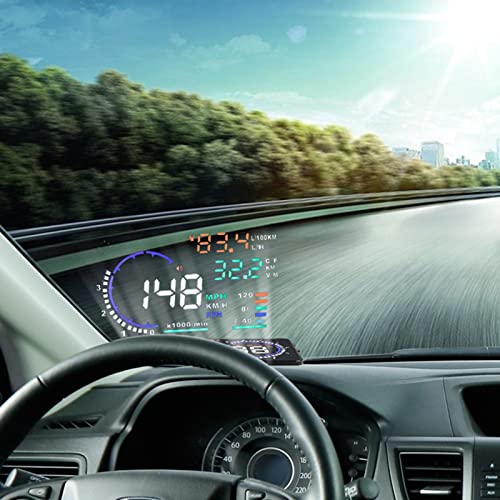
- Shows speed, engine data, temperature, voltage, and mileage
- Includes several driving and vehicle-condition alarms
- Adjustable brightness with automatic power control
Best For: OBDII or EUOBD drivers wanting extensive vehicle data
Best Compact Pick

- GPS+BDS positioning with 10 Hz updates
- USB plug-and-play power
- Large display with calibration and overspeed alert
Best For: Older cars needing a compact, readable speed display
Best Heavy-Duty Pick

- Large screen shows speed and trip information
- Overspeed and fatigue-driving alerts
- Automatic brightness adjustment
Best For: Drivers wanting readable data and long-trip reminders
Best Automatic Setup

- Large HD speed numerals
- Automatic brightness and power control
- Includes projection sticker and adhesives
Best For: Drivers wanting simple, low-effort windshield speed display
Best OBD+GPS Value – wiiyii P6 HUD Speedometer
For drivers comparing car head up displays for older cars, the wiiyii P6 stands out for combining OBD2 data with GPS support. It can show speed, voltage, fuel consumption, RPM, and water temperature, while offering an alternative GPS display for vehicles without OBD2 compatibility.
Best For: Drivers who want broad vehicle data, adjustable mounting, and a backup GPS mode for older or incompatible cars.
Pros:
- Combines OBD and GPS modes, with GPS available when a vehicle lacks OBD2 support.
- Displays numerous driving and vehicle metrics, including speed, voltage, RPM, and water temperature.
- Includes dashboard and windshield mounting options with an adjustable bracket.
- Automatically adjusts brightness and changes ambient lighting to red for overspeed alerts.
Cons:
- The feature-rich interface may take more setup and adjustment than a basic speed display.
- OBD-based readings depend on the vehicle’s supported data and protocol.
The P6 is a practical choice when compatibility and vehicle information matter more than having the smallest possible display. Its dual-mode design makes it especially versatile for older cars.
Best Feature-Rich Upgrade – Wireless CarPlay HUD-V3
This upgraded HUD is a strong option among car head up displays for older cars because its GPS operation does not depend on model-specific OBD compatibility. It adds wireless CarPlay and Android Auto, navigation, diagnostic functions, and speed alerts in a plug-and-play format.
Best For: Owners of older, modified, or non-OBD-compatible vehicles who want navigation and smartphone integration in one dashboard-mounted unit.
Pros:
- Uses GPS for broad compatibility, including older models, modified vehicles, and new-energy cars without OBD connectivity.
- Supports wireless CarPlay and Android Auto with navigation and diagnostic functions.
- Includes both OBD and cigarette-lighter power options.
- Designed for direct sunlight and temperatures from -20°C to 75°C, with overheat protection.
Cons:
- Requires Bluetooth and Wi-Fi to be enabled for the phone connection process.
- The larger feature set may be more than drivers seeking only a simple speed readout need.
With its GPS-based compatibility and smartphone features, the HUD-V3 is the most versatile pick in this group. It is particularly appealing when an older car needs modern navigation without wiring modifications.
Best Compact Basic Display – M22 Overspeed HUD
For shoppers seeking straightforward car head up displays for older cars, the compact M22 offers a simple dashboard display with a small footprint. Its included reflective film, USB cable, and anti-slip pad provide the essential accessories for installation.
Best For: Drivers who prioritize a lightweight, space-saving HUD for basic overspeed awareness.
Pros:
- Compact dimensions and a very light 40 g design take up minimal space.
- Includes a reflective film, USB cable, anti-slip pad, and instructions.
- Designed for use with all vehicles according to the supplied product listing.
Cons:
- The supplied notes provide limited information about displayed metrics and vehicle connectivity.
- No detailed OBD2 or GPS functionality is specified.
The M22 may suit buyers who want a small, uncomplicated HUD rather than a full vehicle-data system. Because the listing gives few technical details, confirm the supported display functions before purchasing.
Best Clear OBD2 Readout – Dual-Mode Car HUD
This dual-mode unit is a practical contender among car head up displays for older cars that support OBD II or EUOBD. Its 3-inch high-definition screen shows speed and useful engine information, while nanotechnology is intended to reduce unwanted reflections.
Best For: Drivers with an OBD II or EUOBD-equipped car who want readable speed, engine, and warning information.
Pros:
- Offers a 3-inch high-definition display with reflection-reducing technology.
- Shows speed, RPM, water temperature, battery voltage, and multiple alerts.
- Supports kilometer/mile and Celsius/Fahrenheit switching.
- Automatically powers on with the vehicle and shuts down to help protect the battery.
Cons:
- Compatibility is specified for vehicles with OBD II or EUOBD systems.
- The supplied notes do not identify a GPS fallback mode for cars without supported OBD connectivity.
This HUD balances a readable screen with useful diagnostic-style information and automatic power management. It is a sensible match for older cars that have the required OBD connection and drivers who want more than speed alone.
Best GPS Pick – Universal 3D GPS HUD
For drivers comparing car head up displays for older cars, this universal GPS model is a straightforward option when you want speed information without relying on the vehicle’s OBD system. It uses GPS, connects through a 5V system, and works with many 12V electric, hybrid, and gas vehicles.
Best For: Older vehicles and drivers who want simple GPS-based speed tracking with safety alerts.
Pros:
- 3000-lumen display automatically adjusts for brighter daytime conditions and nighttime use.
- Shows speed, time, trip distance, altitude, and GPS signal strength across six display modes.
- Includes overspeed and fatigue-driving reminders.
- Plug-and-play setup through the car’s lighter port, with automatic power on and off.
Cons:
- Not compatible with 24V or higher heavy trucks.
- GPS speed tracking does not provide the vehicle-data diagnostics available from OBD-based units.
Its GPS-based design makes this a practical fit for older cars that may not have a compatible diagnostic port. Check the vehicle’s power setup and available dashboard space before buying.
Best Large-Screen Option – Wiiyii A8 OBD HUD
The Wiiyii A8 is worth considering among car head up displays for older cars if the vehicle has an OBDII or EOBD port. Its 5.5-inch HD screen presents speed and multiple vehicle readings, while its plug-and-play design is intended for compatible cars.
Best For: Owners of compatible post-OBDII or EOBD vehicles who want a large display and broader vehicle data.
Pros:
- Large 5.5-inch, 800×480 HD display for easier viewing.
- Displays speed, water temperature, voltage, distance, and alarm information.
- Supports kilometer and mile readouts.
- Can read fault information and support failure detection, alarms, and clearing.
Cons:
- Only applies to OBDII and EOBD vehicles.
- Does not support OBD I or JOBD systems.
This model offers more vehicle information than a basic GPS speedometer, but compatibility is the key consideration. Confirm that the car uses OBDII or EOBD before choosing it for an older vehicle.
Best Data-Rich OBD Pick – 5.5-Inch Multi-Color HUD
This 5.5-inch OBDII/EUOBD unit is another option for shoppers seeking car head up displays for older cars, especially when the vehicle supports the required diagnostic interface. It combines adjustable display brightness with speed, engine, temperature, voltage, fuel-consumption, and warning information.
Best For: Drivers with OBDII or EUOBD cars who want multiple dashboard readings and configurable alerts.
Pros:
- Displays speed, engine speed, water temperature, battery voltage, fuel consumption, and mileage.
- Provides overspeed, fatigue-driving, high-temperature, low-voltage, and shift reminders.
- Uses adjustable brightness and nano-technology intended to reduce reflections.
- Turns on and off automatically with the vehicle.
Cons:
- Requires an OBDII or EUOBD-compatible vehicle.
- Its broad data display may be more than needed if you only want basic speed information.
With its wide range of readings and alerts, this HUD suits drivers who want a more informative display than a speed-only device. Verify interface compatibility before ordering, since it is not presented as a universal GPS model.
Best Compact Pick – K4 GPS Car HUD
For drivers comparing car head up displays for older cars, this compact K4 model offers plug-and-play USB power and a clear speed readout without requiring a factory-installed infotainment system. Its GPS and BDS positioning, adjustable brightness, and speed calibration make it a practical aftermarket option.
Best For: Older-car owners who want a small, simple GPS speed display with customizable alerts.
Pros:
- Dual GPS+BDS reception with a 10 Hz refresh rate and support for up to 32 satellite signals.
- USB-powered installation, with switchable MPH/KM/H display modes.
- Large, anti-reflective numerals, adjustable brightness, speed calibration, and overspeed alerts.
Cons:
- GPS performance can be affected in tunnels, underground garages, heavy rain or fog, and behind metallic windshield film.
- Requires a USB power source rather than a fully wireless setup.
The K4 is a straightforward choice when you primarily need an easy-to-read speedometer and a customizable speeding warning. Its compact ABS housing should fit unobtrusively on many dashboards, while the calibration function can help match the vehicle’s existing speed reading.
Best Heavy-Duty Pick – SinoTrack 5.5-Inch GPS HUD
Among car head up displays for older cars, the SinoTrack stands out for its 5.5-inch LCD and broad set of travel information. It can show speed alongside driving time, mileage, direction, and satellite information, making it useful when a car lacks a modern information display.
Best For: Drivers who want a large, information-rich screen with overspeed and fatigue reminders.
Pros:
- Large 5.5-inch display shows speed, driving time, mileage, time, direction, and satellite data.
- Includes configurable overspeed and fatigue-driving alerts.
- Automatic light-sensitive brightness adjustment and one-key menu operation.
Cons:
- It must use a 5V power supply; supplying more than 5V is prohibited.
- Distance data does not persist or accumulate when the vehicle is powered off.
- The larger screen may take more dashboard space than compact HUDs.
The SinoTrack is a good fit if readability and extra driving data matter more than minimal size. Its automatic brightness feature can simplify day-to-night use, while the fatigue reminder adds a useful long-trip prompt, though buyers should plan carefully for its 5V power requirement.
Best Automatic Setup – Large-Font GPS Windshield HUD
This large-font model is a convenient option for shoppers seeking car head up displays for older cars with minimal installation. Attach the supplied projection sticker, connect the USB cable, and allow the unit to acquire its GPS signal; it then provides a clear speed display designed for quick viewing.
Best For: Older-car drivers who prioritize automatic operation, large numerals, and simple windshield projection.
Pros:
- GPS and BeiDou dual-chipset design with a 10 Hz refresh rate for frequent speed updates.
- Large HD font is designed to be easy to see without looking down.
- Automatic brightness, automatic power on/off, and included projection sticker and adhesives.
Cons:
- Initial satellite synchronization takes approximately 1–3 minutes.
- Brightness scheduling relies on GPS time and dims at 18:00, which may not suit every lighting situation.
- Requires a vehicle USB port or compatible USB power source.
The main appeal here is low-effort daily use: the display powers with the vehicle, adjusts brightness automatically, and uses large speed numerals. It is especially practical for cars without a built-in digital speed display, provided the installation location works well with the supplied projection sticker.
How We Picked the Best Car Head Up Displays for Older Cars
We focused on displays that suit vehicles without a factory head-up system, prioritizing straightforward installation, readable speed information, useful alerts, and broad vehicle compatibility. The selection includes both GPS units that work independently of the car’s electronics and OBD2 models that can read data directly from compatible vehicles.
We also considered practical details such as adjustable brightness, MPH and KM/H support, windshield visibility, display size, USB power, speed alarms, fatigue reminders, and—where available—wireless CarPlay or Android Auto. Because product listings can vary by seller and revision, confirm the included cable, supported protocols, and exact features before ordering.
Quick Comparison
| Type | Best For | Main Advantage | Check Before Buying |
|---|---|---|---|
| GPS HUD | Older or incompatible cars | Independent speed tracking | Signal accuracy and startup time |
| OBD2 HUD | Cars with a compatible diagnostic port | Access to vehicle data | OBD2/EOBD compatibility |
| CarPlay/Android Auto HUD | Drivers wanting smartphone features | Navigation and media integration | Phone compatibility and mounting space |
| Large-screen HUD | Drivers who prioritize readability | Large digits and visibility | Windshield reflection and brightness |
Key Buying Factors for Car Head-Up Displays for Older Cars
Compatibility and Installation
GPS models are usually the safest choice for older cars because they generally need only USB power and a clear dashboard or windshield position. OBD2 units are often more informative, but the vehicle must have a compatible port and communication protocol. Check whether the cable length and connector placement will work in your cabin.
Display Clarity and Adjustment
Look for large, high-contrast digits, adjustable brightness, and a display position that does not block your view. Windshield projection can appear doubled or washed out in bright conditions, so a reflective film or included screen may be useful. Make sure the unit supports your preferred MPH or KM/H setting.
Alerts and Extra Functions
Overspeed warnings and fatigue-driving reminders can add value, but they should complement—not replace—your attention. Some models offer engine data, voltage readings, navigation, CarPlay, or Android Auto. Choose only the features you will actually use, since a simpler display may be easier to read and configure.
Who Should Buy Which Car Head Up Displays for Older Cars?
Choose a GPS HUD if you want the easiest upgrade for an older, classic, or electrically incompatible vehicle. Choose an OBD2 model if you want vehicle-derived readings and have confirmed port compatibility. Choose a CarPlay or Android Auto model if smartphone navigation and media controls are more important than a basic speed display. Choose a large-font, adjustable-brightness unit if visibility is your top concern.
Before purchasing, verify the product’s dimensions, power method, measurement units, alert settings, and return policy. Mount the display where it remains visible without obstructing the road, and test its speed reading against a trusted reference before relying on it.