The best car head-up displays for daily driving put speed and other useful information within your natural line of sight, helping reduce the need to glance down at the dashboard. The models in this roundup range from simple GPS speedometers to feature-rich units with OBD2 data, wireless smartphone integration, and adjustable brightness.
Use the guide below to compare installation, display visibility, compatibility, and everyday usability before choosing the HUD that best fits your vehicle and driving routine.
Best 10 Car Head Up Displays for Daily Driving Picks for 2026
Large-Screen Safety Monitor

- Large screen shows multiple driving details
- Overspeed and fatigue alerts support safer trips
- Automatic brightness adapts to changing light
Best For: Drivers wanting a large GPS display with safety reminders
OBD Information Display

- Shows speed plus key vehicle readings
- Brightness can adjust automatically or manually
- Powers on and off with the vehicle
Best For: OBD II vehicle owners wanting broader dashboard data
GPS Safety Companion

- GPS and Beidou support plug-and-play operation
- Three overspeed alarm levels are available
- Four modes include speed, compass, and clock views
Best For: Drivers wanting adjustable alerts and simple USB installation
Connected Navigation Upgrade

- Adds wireless CarPlay and Android Auto
- Combines navigation, diagnostics, and speed alerts
- Supports OBD and cigarette-lighter power
Best For: Drivers wanting connected navigation and broader HUD functions
Best GPS Accuracy

- 10 Hz GPS+BDS reception
- USB plug-and-play setup
- Brightness, calibration, and overspeed controls
Best For: Simple GPS speed monitoring for daily driving
Best Vehicle Data Range
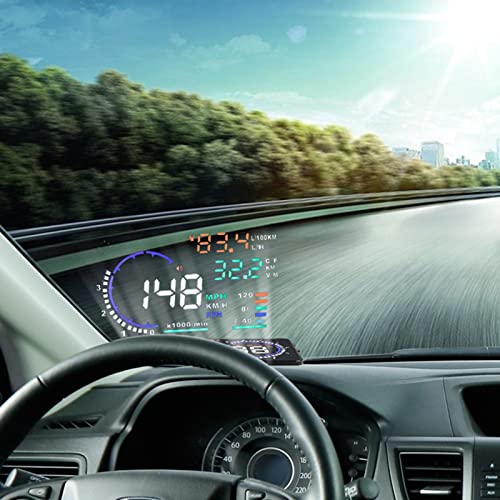
- Displays speed and engine data
- Overspeed, fatigue, and voltage alerts
- Automatic power and brightness control
Best For: Compatible OBD II/EUOBD vehicles needing extra dashboard data
Best Display Flexibility

- 10-plus configurable display layouts
- 5.5-inch screen with rotating bracket
- GPS/Beidou trip and driving data
Best For: Customizable speed and trip information with flexible mounting
Best Data-Rich OBD2 HUD

- Large HD screen with auto brightness
- Displays multiple vehicle metrics
- Includes OBD2 diagnostics and alerts
Best For: Drivers wanting speed and vehicle-health information in one display
Best Connected HUD
Wireless CarPlay and Android Auto Display

- Adds wireless CarPlay and Android Auto
- HD anti-reflection screen
- Supports Bluetooth audio and hands-free calls
Best For: Older vehicles needing portable smartphone connectivity
Best Simple GPS HUD

- Clear large-font HD speed readout
- GPS and BeiDou positioning
- USB setup with auto brightness
Best For: Drivers wanting a focused, easy-to-read GPS speed display
Large-Screen Safety Monitor – SinoTrack 5.5-Inch GPS HUD
For drivers comparing car head up displays for daily driving, the SinoTrack stands out with a large 5.5-inch GPS screen and useful safety reminders. It shows speed, driving time, mileage, time, and direction, while automatic brightness adjustment helps keep the display readable in changing light.
Best For: Drivers who want a large, GPS-based speed display with overspeed and fatigue alerts.
Pros:
- Displays speed, direction, time, mileage, and satellite information together.
- Provides overspeed and four-hour fatigue-driving alerts.
- Automatic light sensing adjusts screen brightness for day and night use.
- One-key controls make display modes and settings easy to change.
Cons:
- It only records the current trip distance and cannot accumulate mileage while powered off.
- It requires a 5V power supply; higher voltage must not be used.
The SinoTrack is a practical choice when visibility and driver reminders matter more than advanced navigation features. Its large screen and GPS operation make it well suited to everyday trips, provided the power requirement is observed.
OBD Information Display – 5.5-Inch Multifunction HUD
This 5.5-inch model is a versatile option among car head up displays for daily driving, especially for compatible OBD II and EUOBD vehicles. It can show speed, coolant temperature, battery voltage, fuel consumption, and mileage, with automatic or manual brightness control.
Best For: Owners of compatible OBD II vehicles who want vehicle data and alerts in one windshield display.
Pros:
- Displays speed, water temperature, battery voltage, fuel consumption, and mileage.
- Nanometer-treated screen is designed to reduce reflections.
- Supports automatic or manual brightness adjustment.
- Automatically powers on and off with the vehicle.
Cons:
- Compatibility is limited to OBD II or EUOBD vehicles meeting the stated model-year guidelines.
- The manufacturer recommends professional installation.
This HUD is a good fit for drivers who want more than speed information and whose vehicle meets the compatibility requirements. Its automatic power behavior and broad data display make it convenient for routine use.
GPS Safety Companion – Dual-Mode Speedometer HUD
For car head up displays for daily driving, this GPS speedometer focuses on simple installation, clear information, and configurable alerts. Its GPS and Beidou dual-mode chip provides speed, time, direction, and trip details, while the automatic light sensor and integrated light shield help manage visibility.
Best For: Drivers seeking a plug-and-play HUD with multiple speed alerts and flexible display modes.
Pros:
- Uses GPS and Beidou signals for positioning and speed data.
- Offers three separate overspeed alarm settings.
- Includes four display modes, including speed, compass, and clock views.
- Automatically powers down completely when the vehicle is turned off.
Cons:
- It requires a vehicle 5V USB interface or a cigarette-lighter-to-USB power source.
- Some settings, including speed calibration and alarms, require manual adjustment through the buttons.
This model is well suited to everyday drivers who prefer a compact, adjustable display without complex installation. The multiple alarm levels and clock mode add practical flexibility for commuting and longer drives.
Connected Navigation Upgrade – Wireless CarPlay HUD System
This connected system takes a more advanced approach to car head up displays for daily driving by combining a high-definition HUD with wireless CarPlay, Android Auto, navigation, diagnostic functions, and speed alerts. It supports OBD or cigarette-lighter power and is designed for broad vehicle compatibility, including older, modified, and some non-OBD vehicles.
Best For: Drivers who want smartphone connectivity, navigation, and vehicle information in a plug-and-play dashboard system.
Pros:
- Supports wireless CarPlay and Android Auto for connected driving features.
- Includes navigation, diagnostic functions, and speed-alert capability.
- Offers both OBD and cigarette-lighter power options.
- Designed for sedans, trucks, SUVs, RVs, pickup trucks, and vehicles without OBD connectivity.
Cons:
- Phone setup requires Bluetooth and Wi-Fi to remain enabled.
- The OBD power system may take 10–15 minutes to shut off after parking.
- It has a stated operating range of -20°C to 75°C and may cut power above 75°C.
This is the most feature-rich option in the group for drivers who want connected navigation rather than a basic speedometer. Its broad compatibility and dual power options add convenience, while the wireless setup introduces more configuration than simpler GPS-only units.
Best GPS Accuracy – K4 Car HUD
For drivers comparing car head up displays for daily driving, the K4 focuses on readable speed information and strong satellite reception. Its GPS+BDS dual-mode chip, 10 Hz refresh rate, adjustable brightness, and USB plug-and-play setup make it a practical choice for everyday routes.
Best For: Drivers who want a simple GPS speed display with speed calibration and overspeed alerts.
Pros:
- GPS+BDS reception can track up to 32 satellite signals and refreshes at 10 Hz.
- USB-powered setup is quick and straightforward.
- Supports MPH/KM/H switching, manual speed calibration, and adjustable brightness.
- Offers customizable overspeed alerts and a large, anti-reflective display.
Cons:
- GPS performance may be affected in tunnels, garages, severe weather, or behind metallic windshield film.
- It displays GPS-based information rather than the broader vehicle data offered by OBD units.
The K4 is a focused, compact option for speed-conscious drivers who value easy installation and visibility over extensive diagnostics.
Best Vehicle Data Range – 5.5-Inch OBD HUD
This 5.5-inch OBDII/EUOBD unit stands out among car head up displays for daily driving by showing more than speed. It can present engine, temperature, voltage, fuel-use, mileage, and fault-code information, while automatic power control and brightness adjustment help reduce daily fuss.
Best For: Drivers with a compatible OBD II or EUOBD vehicle who want broader dashboard and warning information.
Pros:
- Displays speed, engine speed, water temperature, battery voltage, fuel consumption, and mileage.
- Can show vehicle fault codes and provide high-temperature and low-voltage warnings.
- Offers manual and automatic brightness adjustment with reflection-reducing display technology.
- Includes overspeed and fatigue-driving reminders plus automatic power on and off.
Cons:
- Compatibility is limited to vehicles with OBD II or EUOBD systems.
- Its many data readouts may be more than drivers seeking only a simple speed display need.
Choose this model when vehicle compatibility is confirmed and dashboard-style diagnostics are more useful to you than a minimal GPS-only readout.
Best Display Flexibility – G12 Multifunction HUD
The G12 is a versatile choice among car head up displays for daily driving, combining GPS and Beidou positioning with multiple configurable screen layouts. Its 5.5-inch borderless display, USB connection, and rotating bracket make it easy to position for different driving setups.
Best For: Drivers who want customizable displays for speed, trip information, direction, and driving reminders.
Pros:
- GPS and Beidou dual-mode support is designed for faster satellite searching.
- Provides more than 10 interface combinations to suit different preferences.
- Displays speed, time, trip duration, mileage, acceleration time, coordinates, and direction.
- Includes speed alerts, fatigue reminders, USB plug-and-play installation, and a 360-degree rotating bracket.
Cons:
- The larger 5.5-inch body may require more dashboard space than compact HUDs.
- It is a GPS-based display and does not list OBD vehicle diagnostics among its functions.
The G12 suits drivers who want more layout and trip-data choices than a basic speedometer, especially when flexible mounting is important.
Best Data-Rich OBD2 HUD – 5.5-Inch Vehicle Monitor
For drivers comparing car head up displays for daily driving, this model stands out with a large 5.5-inch screen and broad vehicle-data coverage. It displays GPS speed, RPM, water temperature, voltage, and fuel consumption, while automatic brightness adjustment helps readability in changing light.
Best For: Drivers who want speed information plus OBD2 vehicle monitoring and diagnostic features.
Pros:
- Large HD display with automatic brightness adjustment.
- Shows speed, RPM, water temperature, voltage, and fuel consumption.
- Supports OBD2 diagnostics, failure alerts, and failure-code clearing.
- Plug-and-play setup for compatible OBD2/EOBD vehicles, widely used after 2003.
Cons:
- Requires a compatible OBD2 or EOBD vehicle.
- Its extensive data and diagnostic functions may be more than some drivers need.
This is a practical choice when a HUD should do more than project speed. Its OBD2 connection and vehicle alerts make it especially useful for owners who want extra information without installing a separate gauge system.
Best Connected HUD – Wireless CarPlay and Android Auto Display
Among car head up displays for daily driving, the VIVIHUD V3-SE is designed for drivers who want smartphone connectivity without replacing the factory screen. It supports wireless Apple CarPlay and Android Auto, Bluetooth audio, hands-free calls, screen mirroring, and navigation access through a portable plug-and-play display.
Best For: Drivers with older vehicles who want wireless smartphone integration and a dedicated display.
Pros:
- Supports wireless Apple CarPlay and Android Auto.
- Provides HD anti-reflection viewing for daylight, tunnels, rain, and night driving.
- Includes Bluetooth audio, hands-free calling, and screen mirroring.
- Adjustable viewing angle and non-slip base help keep the unit stable.
Cons:
- Smartphone features require a compatible iPhone or Android device.
- It focuses on connectivity rather than detailed OBD2 vehicle data.
The V3-SE is a strong fit for upgrading an older car without modifying its dashboard. Its value comes from combining navigation, media, calling, and phone-assistant access in a standalone display.
Best Simple GPS HUD – Large-Font Speedometer
For straightforward car head up displays for daily driving, this GPS model concentrates on clear speed projection and easy USB power. Its large-font HD readout, GPS and BeiDou positioning, 10Hz refresh rate, and automatic brightness and power controls are aimed at quick, low-distraction speed checks.
Best For: Drivers who primarily want a simple, readable GPS speed display.
Pros:
- Large-font HD speed display is designed for quick viewing.
- GPS and BeiDou dual-chipset architecture supports stronger satellite reception.
- 10Hz refresh rate provides rapidly updated speed data.
- USB plug-and-play setup with automatic power and brightness adjustment.
Cons:
- It displays speed rather than the broader vehicle data offered by an OBD2 monitor.
- Satellite initialization can take approximately 1–3 minutes.
- Requires a windshield projection sticker and a vehicle USB port.
This model makes sense for buyers who prefer a focused speedometer instead of a multifunction dashboard. The large figures and automatic controls keep daily operation simple, while the GPS-based design avoids requiring an OBD2 connection.
How We Picked the Best Car Head Up Displays for Daily Driving
We focused on features that matter during regular commuting, errands, and longer road trips rather than racing-oriented extras. The selection includes GPS-based units, OBD2/EOBD displays, and hybrid models so drivers can compare simple plug-and-play installation with deeper vehicle-data access.
We also considered screen size, digit readability, brightness adjustment, speed-alert functions, power requirements, windshield projection quality, and compatibility with modern vehicles. Smartphone connectivity was treated as a useful bonus, not a substitute for reliable speed information.
Quick Comparison
| HUD type | Best for | Main advantage | Potential limitation |
|---|---|---|---|
| GPS speedometer | Most everyday drivers | Broad vehicle compatibility and simple installation | May not show detailed engine data |
| OBD2/EOBD HUD | Drivers wanting vehicle information | Can display data such as engine speed or coolant readings | Compatibility varies by vehicle and protocol |
| CarPlay or Android Auto HUD | Connected commuters | Combines navigation, calls, and media features | Usually costs more and requires additional setup |
| Large-screen projector | Drivers prioritizing readability | Large digits and more visible alerts | Can take up more dashboard or windshield space |
Key Buying Factors for Car Head-Up Displays for Daily Driving
GPS Versus OBD2
GPS models generally work across more vehicles and are a practical choice when you mainly need speed, direction, or mileage information. OBD2 models can provide richer data, but confirm that your vehicle supports the required port and communication standard. Some units offer both GPS and OBD2 inputs for greater flexibility.
Visibility and Brightness
Look for large, high-contrast numbers, automatic or adjustable brightness, and an anti-glare display. A projected image should remain readable in bright daylight without becoming distracting at night. Check whether the unit uses a reflective film, a built-in screen, or a dashboard-mounted display.
Alerts and Driving Information
Overspeed warnings can be helpful, particularly when settings are easy to adjust. Fatigue alerts, voltage readings, mileage, and navigation information may also be useful, but avoid paying for features that make the screen crowded or difficult to read.
Installation and Power
USB-powered units are usually straightforward to install, while OBD2 models need access to the diagnostic port and careful cable routing. Choose a stable mounting position that does not block the windshield, instruments, or airbag deployment areas.
Who Should Buy Which Car Head Up Displays for Daily Driving?
- Choose a GPS speedometer HUD if you want the easiest setup and dependable speed display across many vehicles.
- Choose an OBD2 model if your vehicle is confirmed compatible and you want additional diagnostic or engine information.
- Choose a large-screen model if readability is your top priority or you frequently drive in changing light conditions.
- Choose a CarPlay or Android Auto HUD if you want navigation and smartphone functions alongside speed information.
- Choose an adjustable, feature-rich unit if multiple drivers will use the vehicle and you need flexible brightness, units, or alert settings.
Before buying, verify the supported speed units, vehicle compatibility, mounting method, power connection, and return policy. The best HUD is the one that stays readable, remains stable, and provides only the information you can safely use at a glance.