Finding the right car diagnostic scanner can make a check-engine light less mysterious and help you decide whether a repair is urgent, manageable at home, or best left to a professional.
This roundup compares 10 options ranging from straightforward code readers to advanced bidirectional scan tools with service resets, live data, battery testing, and wider system coverage.
Best 10 Car Diagnostic Scanners Picks for 2026
Best All-System Value

- All-system engine, transmission, ABS, and SRS diagnostics
- 12-plus resets and workshop service functions
- Lifetime updates with free RepairSolutions2 access
Best For: DIYers and professionals wanting broad coverage and common resets
Best for Advanced Active Tests
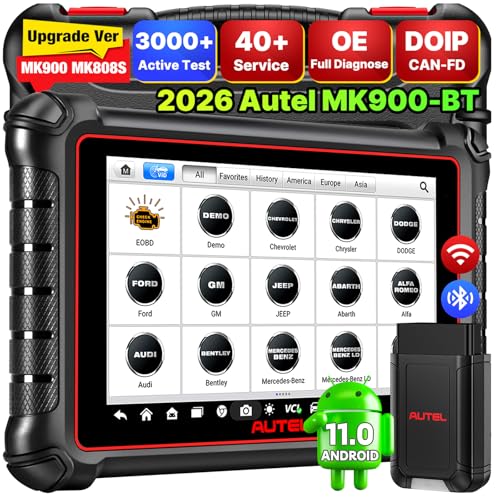
- 3,000-plus listed bidirectional active tests
- 40-plus service functions and all-system scans
- CAN FD, DoIP, AutoVIN, and report support
Best For: Professionals needing component control and broad vehicle coverage
Best Budget Four-System Scanner

- Covers engine, ABS, SRS, and transmission systems
- Out-of-box operation with live data and AutoVIN
- Protective case and lifetime updates included
Best For: Owners diagnosing major warning lights on a budget
Best 2-in-1 Pick
ANCEL AD410 PRO Battery Tester Scanner

- Combines engine diagnostics and 12V battery testing
- Displays live data and freeze-frame information
- Includes lifetime updates and a sunlight-readable screen
Best For: DIY owners needing both code reading and battery-system checks
Best Multi-System Upgrade
LAUNCH CRP123I V3.0 Elite Scanner

- Diagnoses engine, ABS, SRS, and transmission systems
- Adds seven reset and maintenance functions
- Includes touchscreen graphing and lifetime updates
Best For: DIY mechanics and technicians needing wider system coverage
Best Basic DIY Scanner

- Reads and clears engine and emissions codes
- Includes live data, EVAP, O2, and readiness tests
- Requires no battery, app, Bluetooth, or charger
Best For: Beginners handling check-engine and emissions troubleshooting
Best Connected Scanner
BLCKTEC 440 Bluetooth OBD2 Scanner

- Live data graphing and code interpretation
- I/M readiness checks with color-coded LEDs
- Free lifetime updates and 2.8-inch color screen
Best For: DIYers who want live data and smog-readiness tools
Best Basic Code Reader
ANCEL AD310 Classic OBD2 Scanner
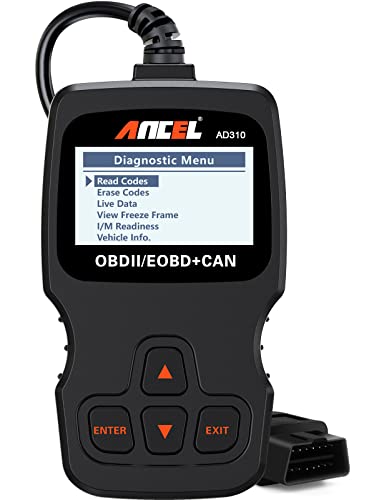
- Reads and clears emission-related engine codes
- Supports major OBD2 protocols and CAN
- Compact, sturdy, and vehicle-powered
Best For: Basic check-engine-light diagnosis at home or on the road
Best Budget Feature Set
MOTOPOWER MP69033 OBD2 Scanner

- Built-in DTC lookup library and live data
- Supports nine OBD2 protocols
- Six languages and adjustable 2.8-inch LCD
Best For: Budget buyers wanting live data and basic engine diagnostics
Best All-System Value – BLCKTEC 460T
For DIYers who want more than basic code reading, the BLCKTEC 460T is one of the more versatile car diagnostic scanners in this lineup. It combines all-system diagnostics with live data, automatic vehicle identification, and a broad selection of service resets. Check BLCKTEC’s compatibility tool first, since available functions vary by vehicle.
Best For: Home mechanics and professionals who need broad system coverage and common maintenance resets.
Pros:
- Scans engine, transmission, ABS, SRS, and other available systems.
- Offers 12-plus service functions, including oil, EPB, SAS, DPF, throttle, battery, and TPMS-related functions.
- Provides live data, freeze-frame information, graphing, recording, and AutoVIN.
- Includes lifetime updates and access to RepairSolutions2 without a subscription fee.
Cons:
- Specific diagnostic and reset functions depend on vehicle year, make, and model.
- It is a diagnostic tool, so identifying a fault does not physically repair it.
The 460T is a strong middle-ground choice for buyers who want professional-style coverage without jumping to a much larger bidirectional platform. Its compatibility checker is essential before purchase.
Best for Advanced Active Tests – Autel MaxiCOM MK900BT
The Autel MaxiCOM MK900BT is aimed at users who need advanced car diagnostic scanners with bidirectional control. Its feature set includes all-system scanning, more than 40 service functions, and thousands of listed active tests, though compatibility must be confirmed for the vehicle and desired functions.
Best For: Repair professionals and experienced DIYers who need bidirectional testing across many vehicle systems.
Pros:
- Supports 3,000-plus listed active tests for commanding and monitoring components.
- Provides all-system diagnostics, AutoVIN, Auto Scan 2.0, live data, and diagnostic reports.
- Offers more than 40 service functions across numerous vehicle makes.
- Supports newer CAN FD and DoIP protocols.
Cons:
- Only one year of software updates is included.
- Active tests and service functions are not available for every vehicle.
- Battery testing requires the separately purchased BT506 accessory.
The MK900BT makes the most sense when active testing is central to your work. It is more capable than a standard code reader, but buyers should verify compatibility and account for future update costs.
Best Budget Four-System Scanner – FOXWELL NT604 Elite
The FOXWELL NT604 Elite is a practical choice among car diagnostic scanners for owners who mainly need to investigate check-engine, ABS, SRS, and transmission warnings. It works out of the box and adds live data, AutoVIN, and playback features, but it does not provide maintenance resets or relearns.
Best For: Car owners who want affordable coverage of four major systems without service-function extras.
Pros:
- Diagnoses engine, ABS, SRS, and transmission systems.
- Comes with current software installed and requires no extra software fee.
- Includes live data, a DTC library, playback, printing, and I/M readiness checks.
- Includes a solid protective carrying case and lifetime updates.
Cons:
- Does not support oil resets, battery registration, ABS bleeding, throttle relearn, or similar maintenance functions.
- SRS crash or collision data cannot be cleared.
- Coverage and AutoVIN performance vary by vehicle.
The NT604 Elite is well suited to troubleshooting warning lights before visiting a repair shop. Choose a more advanced scanner if you need resets, relearns, coding, or bidirectional controls.
Best Pro-Level DIY Upgrade – XTOOL D7
The XTOOL D7 is a powerful option for buyers seeking car diagnostic scanners with bidirectional control, extensive service functions, and newer-vehicle protocol support. Its 2026 version adds 64GB of storage, while compatibility still needs to be checked for specific tests, resets, and vehicle models.
Best For: Serious DIYers, mobile technicians, and small shops that need active tests and advanced maintenance functions.
Pros:
- Provides 4,000-plus listed active tests and bidirectional PIDs.
- Includes 39-plus resets, relearns, calibrations, adaptations, and initializations.
- Supports full-system diagnostics, FCA AutoAuth, CAN FD, and DoIP.
- Offers eight live-data graphs, a 5,000mAh battery, and 64GB storage.
Cons:
- Some functions and vehicle coverage require compatibility verification.
- Three years of updates are included rather than lifetime updates.
- Its extensive professional feature set may be more than casual owners need.
The D7 stands out for users who will actually use active tests and service procedures. Its combination of bidirectional control, broad resets, and newer protocol support makes it a compelling shop-oriented upgrade.
Best 2-in-1 Pick – ANCEL AD410 PRO Battery Tester Scanner
The ANCEL AD410 PRO is a practical choice among car diagnostic scanners for drivers who want engine-code troubleshooting and basic battery-system testing in one handheld tool. It reads and clears engine-related codes, displays live data, and tests battery health, cranking, and charging performance without requiring an app or computer.
Best For: DIY owners who want an engine scanner and 12V battery tester in a single device.
Pros:
- Combines OBD2 engine diagnostics with battery, cranking, and charging tests.
- Offers live data, freeze-frame information, EVAP testing, and I/M readiness checks.
- Uses a clear 2.4-inch display, supports 10 languages, and includes lifetime updates.
Cons:
- Does not support ABS, SRS, or transmission systems.
- Is not designed for electric vehicles.
The AD410 PRO stands out when battery troubleshooting matters as much as check-engine diagnosis. Its system coverage is limited, but its two-in-one design can eliminate the need for a separate battery tester.
Best Multi-System Upgrade – LAUNCH CRP123I V3.0 Elite Scanner
The LAUNCH CRP123I V3.0 is one of the more feature-rich car diagnostic scanners in this group, with coverage for engine, ABS, SRS, and transmission systems. Its touchscreen interface, seven reset functions, graphing tools, report sharing, and lifetime updates make it suitable for broader maintenance work than a basic code reader.
Best For: DIY mechanics and technicians who need multi-system diagnostics and service-reset functions.
Pros:
- Checks engine, ABS, SRS, and transmission systems.
- Includes throttle adaptation, oil, SAS, ABS bleeding, BMS, EPB, and DPF functions.
- Features a 5-inch touchscreen, 4-in-1 live-data graphs, report sharing, and lifetime updates.
Cons:
- Compatibility varies by vehicle model and year.
- CAN FD and DoIP coverage may require extra adapters.
- Its broader feature set may be more than casual users need.
Choose the CRP123I V3.0 when basic engine-code reading is not enough. The multi-system coverage and reset functions provide greater diagnostic flexibility, while vehicle compatibility should be confirmed before purchase.
Best Basic DIY Scanner – ANCEL AD410 OBD2 Code Reader
The ANCEL AD410 is a straightforward option for drivers comparing car diagnostic scanners for check-engine troubleshooting. It reads and clears engine and emissions codes, provides built-in code definitions and live data, and plugs directly into the OBD2 port without batteries, Bluetooth, or a phone app.
Best For: Beginners and home mechanics focused on engine-code diagnosis and emissions readiness.
Pros:
- Supports code reading, code clearing, live data, freeze frame, EVAP, O2 sensor, and I/M readiness functions.
- Includes more than 42,000 built-in DTC definitions.
- Uses vehicle power and has a 2.4-inch color display with multilingual support.
Cons:
- Only reads engine and emissions-related codes.
- Does not support ABS, SRS, transmission, bidirectional controls, or service resets.
- Vehicle compatibility should be checked before purchase.
The AD410 keeps everyday diagnostics simple and affordable in concept, making it a sensible glove-box tool for check-engine and emissions questions. Select a more advanced scanner if you need safety-system or transmission diagnostics.
Best Connected Scanner – BLCKTEC 440 Bluetooth OBD2 Scanner
The BLCKTEC 440 is one of the more capable car diagnostic scanners for DIYers who want more than basic code reading. It reads and clears trouble codes, displays live data with graphing, checks emissions readiness, and supports battery and charging-system testing on OBD2-compliant vehicles.
Best For: DIY mechanics who want live-data graphing, smog-readiness checks, and broader diagnostic functionality in a compact scanner.
Pros:
- Provides live data graphing and error-code interpretation.
- Includes I/M readiness hotkeys and color-coded LEDs for emissions checks.
- Features a 2.8-inch color screen, printer compatibility, and free lifetime updates.
- Works with OBD2-compliant cars, SUVs, light trucks, and 12V diesels.
Cons:
- Designed for OBD2-compliant vehicles, so compatibility should be confirmed before purchase.
- Its one-year limited warranty is shorter than the device’s lifetime-update support.
Choose the BLCKTEC 440 if you want a more informative diagnostic experience than a basic code reader provides. Its plug-and-play, vehicle-powered design and live-data tools make it a practical addition to a home garage or DIY toolkit.
Best Basic Code Reader – ANCEL AD310 Classic OBD2 Scanner
The ANCEL AD310 is a straightforward choice among car diagnostic scanners for checking emission-related engine faults. It reads and clears codes, displays freeze-frame and live data, checks I/M readiness, and supports common OBD2 protocols without batteries or a separate charger.
Best For: Drivers and home mechanics who need a portable, easy-to-use engine code reader for OBD2 vehicles.
Pros:
- Reads and clears emission-related diagnostic trouble codes quickly.
- Supports major OBD2 protocols, including CAN, KWP2000, ISO9141, and J1850 variants.
- Has a sturdy 2.5-foot cable, clearly labeled buttons, and a readable screen.
- Draws power directly from the vehicle’s OBDII connector.
Cons:
- Only supports emission-related engine diagnostics.
- Does not diagnose ABS, SRS, transmission, or other non-emission systems.
- Requires an OBDII interface and is not suitable for OBDI vehicles.
The AD310 is a sensible pick when your main goal is identifying the cause of a check-engine light without extra complexity. Its limitations are important, but for basic OBD2 engine-code work, its compact build and broad protocol support are useful.
Best Budget Feature Set – MOTOPOWER MP69033 OBD2 Scanner
The MOTOPOWER MP69033 packs useful everyday functions into an accessible handheld scanner. As car diagnostic scanners go, it offers code reading and clearing, freeze-frame data, I/M readiness, live data flow, a built-in DTC lookup library, and multiple vehicle-information readings.
Best For: Budget-conscious vehicle owners who want a simple screen-based scanner with live data and common engine-diagnostic functions.
Pros:
- Includes a built-in DTC lookup library for interpreting engine codes.
- Displays live data, real-time curves, freeze-frame information, and vehicle speed.
- Supports nine protocols and many 1996-and-newer US, EU, and Asian OBD2 vehicles.
- Offers six languages and a 2.8-inch LCD with adjustable contrast.
Cons:
- Does not support ABS, airbag, oil-service, or other non-OBD2 systems.
- Has a 30-day manufacturer warranty.
- Vehicle compatibility may vary, so the correct OBD2 connection is required.
The MP69033 is a practical option if you want more than a bare-bones code reader while staying focused on engine and emissions-related diagnostics. Its lookup library, live-data views, and broad protocol support add convenience, but it is not intended for advanced module diagnostics.
How We Picked These Car Diagnostic Scanners
We selected tools across several use cases and price levels, prioritizing diagnostic coverage, ease of use, supported functions, update policies, and compatibility. The lineup includes basic OBD2 readers for engine fault codes, midrange scanners that access ABS, SRS, or transmission systems, and advanced tools with bidirectional controls or ECU coding.
We also considered practical ownership details: display quality, live-data support, battery testing, reset functions, connectivity, and whether the scanner is suitable for occasional DIY checks or frequent professional work. Always verify vehicle compatibility before buying, especially for advanced functions.
Quick Comparison
| Best For | Look For | Typical Capability |
|---|---|---|
| Basic DIY diagnosis | Simple OBD2 reader | Read and clear engine codes, view emissions data |
| More complete system checks | ABS, SRS, and transmission access | Diagnose multiple control modules |
| Routine maintenance | Reset services | Oil, EPB, BMS, SAS, DPF, or throttle functions |
| Advanced troubleshooting | Bidirectional controls and coding | Command vehicle components and perform deeper tests |
| Battery-related checks | 12V battery and charging analysis | Assess battery condition and alternator output |
Key Buying Factors for Car Diagnostic Scanners
Vehicle and System Coverage
Basic OBD2 coverage generally focuses on the engine and emissions system. If you need to investigate airbag, brake, transmission, or body-module faults, choose a scanner that explicitly supports those systems for your vehicle. “Full system” claims can vary by make, model, and year.
Functions and Reset Services
Reset features can be useful after maintenance, but they are not universal. Check whether the tool supports the exact services you need, such as oil, electronic parking brake, battery registration, steering-angle calibration, diesel particulate filter, or throttle adaptation.
Live Data and Advanced Testing
Live data helps you observe sensors while the engine runs, while graphing can make intermittent issues easier to spot. Bidirectional tools go further by commanding selected components, although correct procedures and vehicle-specific support are essential.
Updates and Usability
Consider update costs, connection type, screen size, menu clarity, and data storage. A Bluetooth scanner may work well with a phone, while a dedicated handheld is often simpler at the roadside. Confirm whether updates are included, limited, or subscription-based.
Who Should Buy Which Car Diagnostic Scanners?
Choose a basic reader if you mainly want to check or clear a check-engine code before visiting a repair shop. A model with ABS, SRS, and transmission coverage is a better fit for owners who maintain older or higher-mileage vehicles and want broader diagnostics.
Look for battery testing when charging problems are a frequent concern. Choose a scanner with multiple service resets for regular maintenance work, and consider a bidirectional or coding-capable model if you are an experienced DIY mechanic, technician, or enthusiast who needs deeper testing. For any option, verify compatibility with your vehicle and treat the scanner’s diagnosis as information to guide testing—not as a guaranteed repair verdict.