Removing or installing a transmission is considerably safer and more manageable with the right jack. A dedicated transmission jack supports the load, improves positioning, and reduces the need to balance a heavy component manually.
We compared 10 hydraulic models across capacity, lift range, stability, mobility, and garage-friendly features to help you choose a dependable transmission jack for home garage work.
Best 10 Transmission Jack for Home Garage Picks for 2026
High-Capacity Pick
VEVOR 1322 lb Telescoping Transmission Jack

- Supports up to 1,322 lb
- 34.3–68.5-inch hydraulic lift range
- 30° tilting saddle with locking wheels
Best For: Home garages handling larger transmission jobs
Compact Value Pick
MAXSA 450 lb Transmission Jack

- 450 lb Q235 steel frame
- 7–23-inch lift range
- Swivel casters and nylon safety strap
Best For: Moderate-load home garage and undercarriage work
Maximum-Lift Pick
High Lift 1660 lb Hydraulic Transmission Jack

- Supports up to 1,660 lb
- 35–72-inch two-stage lift range
- 30° saddle tilt and retaining chain
Best For: High-capacity drivetrain work in home garages or workshops
Established Heavy-Duty Pick
Sunex Tools 7793B Telescopic Transmission Jack

- 1,000 lb load capacity
- 74-inch maximum height
- Foot pump, tilt saddle, and nylon tie-down
Best For: Dedicated home garage service areas needing extended reach
Best Low-Profile Pick
Garvee 450-Lb Transmission Jack

- 7- to 23-inch low-profile lift range
- 2-meter safety straps and four brake wheels
- 450-lb alloy-steel capacity
Best For: Home garages handling compact cars, trucks, and light-duty repairs
Best Heavy-Duty Lift
Dual Plunger 1322-Lb Hydraulic Jack

- 1322-lb carbon-steel load capacity
- 33.5- to 69-inch two-stage lift
- Foot pedal, tilting tray, and safety chains
Best For: Large garages and heavy transmission or transfer-case service
Best Versatile Floor Jack
1100-Lb Low-Profile Transmission Jack

- 1100-lb alloy-steel load capacity
- 7.68- to 24.8-inch lift range
- Adjustable tilt saddle and four swivel casters
Best For: DIY drivetrain service on cars, SUVs, and light trucks
High-Reach Workhorse
VEVOR Hydraulic Transmission Jack
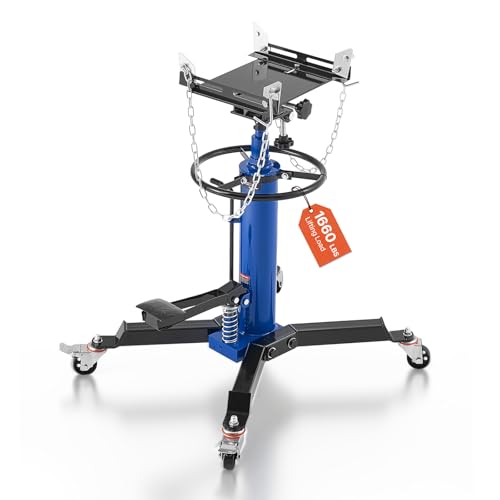
- 1,660-pound steel lifting capacity
- 34.6- to 69.3-inch telescoping range
- 360-degree adjustable tray with foot pedal
Best For: Lift-equipped home garages needing extra height
Best Heavy-Duty Pick
2000 lb Adjustable Hydraulic Transmission Jack

- 2,000-pound heavy-duty capacity
- 6.9-inch minimum height
- Telescoping lift with swivel front casters
Best For: Low-clearance work on lifts or jack stands
Compact Storage Pick
Telescoping Hydraulic Transmission Jack

- 1,650-pound lifting capacity
- 360-degree swivel wheels for tight spaces
- Foldable foot pedal for storage
Best For: Space-conscious garages handling lighter components
High-Capacity Pick – VEVOR 1322 lb Telescoping Transmission Jack
For a transmission jack for home garage work, the VEVOR 1322 lb model offers substantial capacity, tall lifting range, and foot-operated hydraulic adjustment. Its tilting saddle and locking casters are useful when aligning and positioning transmissions on cars and light trucks.
Best For: Home garages that need high lifting capacity and extended height adjustment.
Pros:
- Supports up to 1,322 lb.
- Hydraulic foot pedal adjusts from 34.3 to 68.5 inches.
- 30-degree adjustable saddle, four wheels, and two wheel brakes.
Cons:
- At 96 lb, it is relatively heavy to move or store.
- The base must be installed correctly to maintain proper wheel rotation.
Its strong steel construction and high capacity make it a versatile choice for larger transmission jobs, while the tilt adjustment helps accommodate different transmission shapes.
Compact Value Pick – MAXSA 450 lb Transmission Jack
The MAXSA is a practical transmission jack for home garage owners who want a lighter, lower-profile tool for transmission and undercarriage work. Its 450 lb capacity, adjustable 7-to-23-inch lift, swivel casters, and safety strap suit smaller maintenance tasks.
Best For: Home garages needing a compact jack for moderate-load transmission and undercarriage service.
Pros:
- Q235 steel frame supports up to 450 lb.
- 7-to-23-inch adjustable lift range.
- Four 360-degree swivel casters with two lockable wheels.
- Nylon safety strap helps secure the load.
Cons:
- Lower capacity than the other listed jacks.
- Its maximum 23-inch lift may not suit every vehicle or workspace.
With a listed weight of 46.3 lb and a compact footprint, this model is easier to handle than heavier telescoping jacks, but its capacity should be matched carefully to the transmission being serviced.
Maximum-Lift Pick – High Lift 1660 lb Hydraulic Transmission Jack
This high-lift transmission jack for home garage use combines a 1,660 lb capacity with a 35-to-72-inch telescoping range. A foot pedal, 30-degree tilting saddle, solid casters, and retaining chain support controlled lifting and alignment during drivetrain service.
Best For: Home garages and workshops that need maximum capacity and very high lifting range.
Pros:
- Supports up to 1,660 lb.
- 35-to-72-inch two-stage telescoping lift.
- 30-degree adjustable saddle for alignment.
- Foot-operated lifting and heavy-duty retaining chain.
Cons:
- At approximately 100 lb, it is not especially portable.
- The supplied details list a 90-day manufacturer warranty.
The combination of the highest stated capacity and 72-inch maximum height makes this a strong option for demanding garage work, provided the available storage and floor space can accommodate it.
Established Heavy-Duty Pick – Sunex Tools 7793B Telescopic Transmission Jack
The Sunex Tools 7793B is a heavy-duty transmission jack for home garage projects that need a 1,000 lb rating and an extended 74-inch maximum height. Its foot pump, tilt saddle, nylon tie-down, and overload valve provide useful control during transmission removal and installation.
Best For: Home mechanics who prefer a high-reaching telescopic jack with load-securing features.
Pros:
- 1,000 lb load capacity.
- Foot-operated pump provides hands-free lifting.
- Reaches up to 74 inches and lowers for transfer to a work table.
- Nylon strap and overload valve add load-control features.
Cons:
- At 163.4 lb, it is considerably heavier than the other listed options.
- The supplied details do not specify wheel-lock features.
Its tall maximum height and 1,000 lb rating make it suitable for substantial transmission work, but the unusually high listed weight means it is best kept in a dedicated service area.
Best Low-Profile Pick – Garvee 450-Lb Transmission Jack
If you need a transmission jack for home garage work, the Garvee 450-lb model is a compact option for vehicles with limited ground clearance. Its 7- to 23-inch lift range, safety straps, and locking casters support controlled positioning during transmission repairs.
Best For: Home mechanics servicing passenger cars, compact trucks, and light-duty transmission jobs.
Pros:
- Low 7-inch starting height fits beneath many low-clearance vehicles.
- 2-meter safety straps help secure the load during lifting and lowering.
- Four universal brake wheels provide mobility with locking stability.
- 450-lb capacity is suitable for many car and truck repair tasks.
Cons:
- Its 450-lb capacity is lower than the other jacks in this roundup.
- The maximum 23-inch height may not suit every vehicle or lifting setup.
- Assembly instructions are included, so some setup is required.
Choose this Garvee when a low-profile footprint and straightforward garage maneuverability matter more than maximum capacity or lift height.
Best Heavy-Duty Lift – Dual Plunger 1322-Lb Hydraulic Jack
For demanding transmission work, this dual-plunger hydraulic model offers a 1322-lb capacity and a 33.5- to 69-inch telescoping lift range. It is a substantial choice for a home garage with enough room for taller vehicle-lift or workshop applications.
Best For: Serious DIY mechanics and workshops servicing car and light-truck transmissions at greater working heights.
Pros:
- 1322-lb carbon-steel capacity supports heavy transmission and transfer-case work.
- Dual plungers are designed to reach maximum height in about 20 seconds.
- Two-stage lift, 30-degree tilting tray, and foot pedal support positioning control.
- Two braked swivel casters and safety anchor chains improve handling and load security.
Cons:
- Its 33.5-inch minimum height is not intended for low-clearance floor-jack use.
- At 97 pounds, it is substantially heavier than a compact garage jack.
- The large 25.6-by-31.9-inch footprint requires adequate storage and operating space.
This is the strongest match when capacity, tall lift range, and controlled hydraulic positioning are priorities; it is less practical for a cramped garage or low-profile underbody access.
Best Versatile Floor Jack – 1100-Lb Low-Profile Transmission Jack
This 1100-lb hydraulic transmission jack combines a low 7.68-inch starting height with a 24.8-inch maximum lift. For a transmission jack for home garage use, its adjustable tilt saddle and four swivel casters make it useful for positioning components beneath cars, SUVs, and light trucks.
Best For: DIY mechanics who want low-clearance access and adjustable positioning for general drivetrain service.
Pros:
- 1100-lb heavy-duty steel capacity handles substantial transmission-service loads.
- 7.68-inch minimum height works under vehicles with limited clearance.
- Adjustable forward-and-back saddle tilt helps with alignment.
- Four 360-degree swivel casters support repositioning in confined spaces.
Cons:
- Its 24.8-inch maximum height is lower than the tall dual-plunger model.
- The 99.1-pound weight may make storage and relocation more demanding.
- No safety straps or chains are listed in the supplied specifications.
Consider this model for a home garage that needs a strong, low-profile floor jack with useful saddle adjustment, especially when maneuverability and under-vehicle access are key.
High-Reach Workhorse – VEVOR Hydraulic Transmission Jack
For a home garage with a suitable lift, this transmission jack for home garage use combines a 1,660-pound capacity with an unusually tall 34.6- to 69.3-inch lifting range. Its adjustable tray and foot-operated hydraulic pump are designed to make transmission positioning more controlled.
Best For: Home mechanics working on vehicles supported by a car lift and needing extra lifting height.
Pros:
- Supports up to 1,660 pounds with a heavy-duty steel frame.
- Tray rotates 360 degrees, tilts up to 30 degrees, and adjusts in width.
- Foot pedal provides hands-free raising and controlled lowering.
- Four swivel casters, including two with brakes, improve movement and stability.
Cons:
- Requires the vehicle to be supported by a car lift.
- Its 98.6-pound weight and large frame may be cumbersome in a compact garage.
- Chains are needed to secure lifted components against falling.
The VEVOR is a strong choice when height and tray adjustability matter more than portability. Confirm that your garage lift and available floor space can accommodate its dimensions before buying.
Best Heavy-Duty Pick – 2000 lb Adjustable Hydraulic Transmission Jack
This transmission jack for home garage projects is built around a low 6.9-inch starting height, making it easier to position beneath vehicles with limited clearance. Its 2,000-pound capacity, telescoping hydraulic lift, and swivel casters suit heavier removal and installation work.
Best For: Home garages that need a low-profile jack for vehicles on lifts or jack stands.
Pros:
- 2,000-pound load capacity handles substantial transmissions and components.
- Low-profile design starts at 6.9 inches for easier access.
- Multi-stage telescoping lift supports precise positioning and controlled lowering.
- Wide base and 360-degree swivel front casters improve maneuverability and control.
Cons:
- Maximum lifting height is 31.7 inches, lower than the taller telescoping models here.
- The heavy and bulky shipment should be inspected carefully for damage or missing parts.
- Includes a 90-day limited warranty.
Choose this model if getting under a low vehicle matters more than reaching extreme lift heights. Its higher capacity and stable base make it a practical option for demanding garage jobs.
Compact Storage Pick – Telescoping Hydraulic Transmission Jack
For a space-conscious transmission jack for home garage use, this telescoping model offers a 1,650-pound capacity and a foldable foot pedal for easier storage. Its 360-degree swivel wheels help position transmissions, differentials, and transfer cases in tighter work areas.
Best For: Home mechanics who prioritize maneuverability and compact storage for lighter automotive components.
Pros:
- Supports up to 1,650 pounds with an alloy-steel frame.
- 360-degree swivel wheels help navigate tight spaces.
- Telescoping design reaches a stated maximum height of 78.7 inches.
- Foldable foot pedal saves space when the jack is stored.
Cons:
- Its 46.3-inch minimum height may not suit low-clearance applications.
- At about 40 kg, it is not especially lightweight despite its storage-friendly pedal.
- Includes a 90-day limited warranty.
This model stands out for maneuverability and storage convenience, especially in a crowded home garage. Check the unusually tall minimum and maximum height specifications against your vehicle and lift setup before purchasing.
How We Picked the Best Transmission Jack for Home Garage
We focused on the features that matter most when a transmission jack is used outside a professional shop: rated load capacity, usable lift range, saddle adjustability, frame stability, caster design, and control ergonomics. We also considered low-profile access for vehicles with limited clearance, telescoping height for installation work, foot-pedal operation, safety straps, locking or swiveling casters, and overall portability.
Capacity figures are not the only measure of safety. A jack should be used within its stated rating, on a level surface, with the vehicle properly supported by jack stands. Always secure the transmission before moving or lowering it.
Quick Comparison
| Best For | Look For | Typical Options in This Roundup |
|---|---|---|
| Compact home garages | Low minimum height and a narrow footprint | 450- to 1,100-pound low-profile models |
| Heavy transmissions | At least 1,300 pounds of rated capacity | 1,322- to 2,000-pound hydraulic jacks |
| Large vehicles and high lift points | Extended telescoping lift range | 35- to 72-inch high-lift designs |
| Frequent positioning adjustments | Tilting saddle, swivel casters, and secure restraints | Premium shop-style models |
Key Buying Factors for a Transmission Jack for Home Garage
Capacity and Stability
Estimate the transmission’s actual weight, including fluid and attached components, then leave a meaningful safety margin. A wider steel base and four sturdy casters can matter as much as a high capacity rating because they help resist tipping while the load is being positioned.
Lift Range and Clearance
Check both the minimum and maximum heights. Low-profile models fit beneath vehicles with limited clearance, while taller telescoping jacks are useful for raised trucks, SUVs, and installation tasks. Confirm that the range suits your lift setup before buying.
Saddle Adjustability and Restraint
A tilting or adjustable saddle makes it easier to align the transmission with the engine and bellhousing. Chains or safety straps add valuable retention, especially when the jack must be rolled or angled. Do not rely on the saddle alone to hold an unbalanced load.
Mobility and Controls
Swivel casters improve maneuverability, but they should roll smoothly without excessive play. A foot pump lets you raise the jack while keeping both hands near the load, while controlled hydraulic release helps prevent sudden lowering. Consider storage space and folded-pedal clearance in a smaller garage.
Who Should Buy Which Transmission Jack for Home Garage?
Choose a low-profile 450- or 1,100-pound model if you mainly service lighter passenger vehicles and need easy access under a standard-height car. A 1,322- to 1,660-pound jack is a better all-around choice for heavier transmissions, trucks, and added safety margin. Buyers handling large drivetrains or working on elevated vehicles should prioritize a high-lift model with a broad range and stable base. If alignment and repeated repositioning are common, select an adjustable saddle, safety restraints, foot operation, and smooth 360-degree casters.