The DKGEA C20 Dual Dash Cam review is for drivers who want front-and-rear evidence without building a complicated setup from scratch.
It combines 4K front recording, 1080P rear capture, GPS, WiFi, and a 64GB card in one package.
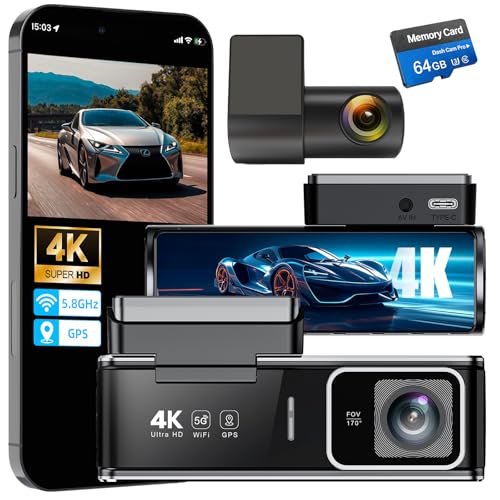
DKGEA C20 Review Summary
The DKGEA C20 Dual Dash Cam is a strong fit for everyday drivers, commuters, rideshare users, and families who want a more complete dash cam package. It stands out because it gives you dual-channel coverage, a useful 3.59-inch screen, built-in GPS, and wireless app access without forcing you to immediately buy extra essentials like a memory card.
If your main goal is to capture incidents clearly from both ends of the car, the DKGEA C20 makes a lot of sense.
The front camera’s 4K recording and the rear camera’s 1080P capture are well matched for insurance evidence, parking lot bumps, and lane-change disputes, while the included 64GB card makes setup more convenient than many bare-bones models.
Scorecard
| Category | Score | Why it matters |
|---|---|---|
| Video quality | 9.0 | Front 4K and rear 1080P recording should capture road detail clearly for incidents, plates, and evidence. |
| Night performance | 8.0 | F1.5 aperture, 6-layer lens, and WDR are built to help in low light, tunnels, and parking areas. |
| App and wireless features | 8.0 | 5.8GHz WiFi and app support make playback and sharing more convenient than slower basic dash cams. |
| Parking surveillance | 8.0 | 24-hour parking mode and time-lapse support are valuable when the unit is hardwired correctly. |
| Installation and usability | 7.0 | Adhesive mounting and included accessories help, but rear camera routing still takes effort. |
| Storage and recording management | 8.0 | Loop recording, G-sensor locking, a 64GB card, and up to 256GB expansion make daily use practical. |
| Hardware and display | 7.0 | The 3.59-inch IPS screen is useful, though still compact compared with larger displays. |
Bottom line: this is a well-rounded dual dash cam for buyers who value evidence quality, parking protection, and convenience more than ultra-premium enthusiast features.
If you want an easy way to cover both the front and rear of your vehicle, the DKGEA C20 is worth serious attention.
Key Features and Specifications of DKGEA C20
The DKGEA C20 Dual Dash Cam is built around practical safety and evidence capture.
Here are the key specs and design choices that matter most to buyers:
| Specification | Details |
|---|---|
| Brand | DKGEA |
| Model | Dual Channel Car Camera-C20 |
| Video capture resolution | 4K front, 1080P rear |
| Field of view | 170 degrees |
| Connectivity | 5.8GHz WiFi, Type-C |
| Display | 3.59-inch IPS widescreen |
| Storage support | Up to 256GB external storage |
| Included memory card | 64GB TF card |
| Mount type | Dashboard / windshield adhesive mount |
| Vehicle compatibility | Cars, trucks, sedans, minivans, buses |
| Special functions | App control, built-in WiFi, G-sensor, night vision, parking monitoring, loop recording |
- Dual-channel recording captures the road ahead and behind at the same time.
- 4K Ultra HD front recording improves detail retention for incidents and license plate capture.
- 1080P rear recording provides valuable coverage in rear-end collisions and parking lot contact.
- 170-degree field of view helps monitor more of the lane and roadside surroundings.
- F1.5 aperture and 6-layer lens are designed to improve low-light clarity.
- WDR and night vision support help balance exposure in difficult lighting.
- 24-hour parking mode and time-lapse recording support parked-vehicle monitoring when hardwired.
- Loop recording and G-sensor locking help the camera keep recording while saving impact clips.
- 5.8GHz WiFi should offer faster transfers than slower wireless setups.
- Built-in GPS logs route, location, and speed data for context after an incident.
One of the biggest practical advantages here is the package completeness.
Many dash cams look good on paper but still require a card and extra accessories before you can use them properly.
The DKGEA C20 includes a 64GB TF card, which means you can install it and start testing it right away.
Pros and Cons of DKGEA C20
If you are comparing the DKGEA C20 Dual Dash Cam pros and cons, the list is fairly balanced, with a strong emphasis on features that matter in real-world driving.
| Pros | Cons |
|---|---|
| Front and rear recording gives broader incident coverage | 24-hour parking mode requires a separately sold hardwire kit |
| 4K front resolution should help with detail capture | Rear camera installation adds complexity versus a single-camera unit |
| Night-focused optics and WDR help in dark conditions | The screen is compact compared with larger in-car displays |
| 5.8GHz WiFi should improve file transfer speed | App, GPS, and WiFi features depend on proper setup and pairing |
| Built-in GPS adds route and speed records | Included 64GB card may be small for drivers who record extensively |
| 64GB card included, reducing add-on purchases | |
| Parking mode and G-sensor improve protection when parked or in a crash |
The biggest strengths are evidence quality and convenience. The biggest drawbacks are installation complexity and the fact that the best parking features need extra hardwiring.
Who Should Buy DKGEA C20?
The DKGEA C20 Dual Dash Cam is a good match for buyers who want a practical, feature-rich dash cam rather than a stripped-down budget model.
It fits especially well for people who drive daily and want front-and-rear protection without piecing together a system from separate parts.
- Commuters who want clear incident footage on busy roads.
- Rideshare and delivery drivers who benefit from dual-camera coverage and GPS logs.
- Family vehicle owners who want parking surveillance and evidence in case of contact damage.
- Drivers who park outdoors and want monitoring support when the vehicle is unattended.
- Buyers who value convenience and want a 64GB card included from day one.
You should probably skip it if you want the simplest possible single-camera setup, if you do not want to route a rear camera cable, or if you are not willing to add a hardwire kit for full parking protection.
How the 4K Front and 1080P Rear Recording Performs
From a buyer’s perspective, resolution is only useful if it translates into usable footage.
In that respect, the DKGEA C20’s 4K front camera is the main selling point, because it should preserve important road details better than older 1080P-only dash cams.
That matters when you need to identify lane position, read signage, or capture a license plate during a short incident window.
The 1080P rear camera is not as headline-grabbing, but it is the right choice for practical rear coverage.
Rear-end collisions, aggressive tailgating, and parking-lot taps are all situations where a rear camera can be just as valuable as the front unit.
A dual system is often the smarter choice if you drive in dense traffic or leave your car in public lots frequently.
What this means for buyers: if you only want front-facing video, a single-channel 4K model may be enough.
But if you want evidence from both directions, the DKGEA C20 is more versatile.
Night Driving and WDR Image Quality
Night performance is one of the most important differentiators in dash cams, because many incidents happen after dark, in garages, or under poor street lighting.
The DKGEA C20 uses an F1.5 aperture, a 6-layer lens, WDR, and night vision support to improve low-light recording.
That combination should help the camera maintain brightness and reduce harsh contrast when headlights, streetlights, and shadows compete in the same frame.
The practical benefit is better visibility of the road surface, vehicles, and surrounding movement in situations where a cheaper camera might produce muddy or overly dark footage.
Of course, no dash cam turns night into day.
But compared with basic units that struggle in dim conditions, this setup is a meaningful upgrade for drivers who commute before sunrise, park outside, or frequently drive in tunnels and city lighting.
Night-driving verdict: the DKGEA C20 looks well thought out for low-light use, and that makes it a stronger buy for real-world driving than models focused only on daytime clarity.
WiFi, App Control, and GPS Tracking
The 5.8GHz WiFi feature is one of the most appealing convenience upgrades in the DKGEA C20 Dual Dash Cam.
Faster wireless transfer usually means you spend less time waiting around to review clips, especially if you want to save a video to your phone quickly after an incident.
App control is useful for playback, file management, and sharing.
That matters because many drivers do not want to remove a memory card every time they need a clip.
With a good app workflow, the dash cam becomes much easier to live with over the long term.
The built-in GPS adds another layer of context by logging route, speed, and location.
For buyers who care about evidence quality, that can be very helpful because it creates a fuller picture of what happened and where.
It is especially useful for commuting, delivery work, and insurance documentation.
One caution: app, GPS, and WiFi features are only as good as the pairing process and setup.
If you prefer a completely plug-and-play dash cam with minimal phone interaction, this may be more feature-rich than you need.
Parking Mode and G-Sensor Protection
Parking surveillance is one of the DKGEA C20’s most attractive safety features, but there is an important detail buyers should not miss: 24-hour parking mode requires a hardwire kit sold separately.
That means the feature is real, but it is not truly plug-and-play if you want the camera to keep working while the vehicle is off.
Once hardwired, the parking mode and time-lapse function can help monitor the car for bumps, vandalism, or suspicious activity.
The G-sensor is also important because it can lock video files during a collision or sudden impact, making it less likely that critical footage gets overwritten during loop recording.
This is exactly the kind of feature set that gives a dash cam long-term value.
Many buyers do not think about parking protection until after an incident, but once you experience a door ding or hit-and-run, you quickly understand why it matters.
Best use case: if your vehicle is regularly parked on the street or in public lots, the DKGEA C20 becomes much more compelling once properly hardwired.
What Comes in the Box and Installation Notes
Another advantage of the DKGEA C20 Dual Dash Cam is that the box is more complete than many rivals.
The package includes the rear camera, a 64GB TF card, mounting accessories, and an adhesive windshield mount, which lowers the number of separate purchases you need before installation.
The Type-C connection is a welcome modern touch, and the compact body should make it easier to place discreetly behind the rearview mirror.
The 3.59-inch IPS widescreen is not huge, but it is large enough to check settings, playback, and framing without making the camera feel bulky.
Installation is still more involved than a single-camera dash cam.
The front camera is straightforward, but the rear cable must be routed neatly through the vehicle.
The included cable trim tool helps, yet buyers should still expect to spend some time doing a clean install.
Installation advice: if you want the best result, plan the routing before you start, especially if you also intend to hardwire parking mode later.
Comparable Alternatives to Consider
If you are still deciding whether the DKGEA C20 Dual Dash Cam is the right fit, it helps to compare it with common dash cam alternatives sold on Amazon.
- Viofo dual dash cam models are a strong choice for enthusiasts who want more advanced tuning and premium-minded hardware.
- 70mai front and rear dash cams often appeal to buyers who want app-friendly features and modern styling in a budget-conscious package.
- Garmin dash cams are worth considering if you want a simpler interface and a well-known brand name.
- 4K single-channel dash cams may be enough if you do not need rear coverage and want a simpler install.
Compared with those options, the DKGEA C20’s strength is balance.
It offers a better out-of-box package than many basic models while still keeping the feature list broad enough for serious everyday use.
DKGEA C20 Dual Dash Cam Pros and Cons in Real-World Use
When evaluating the DKGEA C20 Dual Dash Cam pros and cons, the most important question is not whether it has features, but whether those features help you in daily driving.
Pros in practice: the dual-camera setup means fewer blind spots in your footage, the included card saves setup time, GPS adds context, and 5.8GHz WiFi should make clip transfer more convenient.
For many buyers, those are the exact conveniences that make a dash cam feel worth owning instead of being another gadget that sits untouched.
Cons in practice: installation takes more effort than a front-only unit, parking mode needs extra hardware, and the small screen may not be ideal for users who prefer larger in-car displays.
None of those are deal-breakers, but they are important if you want a minimal, simple system.
This is a feature-rich practical dash cam, not a luxury electronics showcase. That distinction matters because it helps set realistic expectations and makes the value proposition clearer.
Is DKGEA C20 Worth It?
Yes, the DKGEA C20 Dual Dash Cam is worth it for buyers who want strong front-and-rear protection, useful nighttime recording, and a more complete kit out of the box. It is especially appealing if you care about incident evidence, parking surveillance, and easy clip access through WiFi and app support.
It is not the best choice for someone who wants the absolute simplest install or who does not plan to hardwire a parking solution.
But for most drivers who want a well-rounded dual dash cam with 4K front recording, 1080P rear coverage, GPS logging, and included storage, the DKGEA C20 makes a convincing case.
Buying advice: choose the DKGEA C20 if you want a practical, feature-rich dual dash cam that should handle commuting, family use, and outdoor parking better than a basic single-camera setup.
If you need the best parking mode experience, budget for the hardwire kit as part of the purchase plan.